The Concept of Care In Nursing
Caring is considered the central core of nursing and is beneficial for both nurses and patients. As synonymous to nursing, caring is referenced in all text books, scientific articles, legal documents, ethical codes and is characterized as the main responsibility and ethical obligation of the nursing staff. Nevertheless, the meaning and concept of caring have not been clearly defined.
This research program aims to explore, from an international perspective, the meaning of care from the nurses and patients point of view and find common and shared definitions between these partners of caring. In addition, it aims to identify the relationship between nurse caring and patient satisfaction and to clarify the opinion of nurses and patients on individualized nurse caring. In this study, participants from Cyprus, Czech Republic, Finland, Greece, Hungary and Italy unite their efforts in order to achieve the aims of the study.
It is out intention to regularly update this webpage with additional information, results and other relevant materials. We are open to any comments you may have concerning the research topic which may contribute to the further development and improvement of this project.
I welcome all to our webpage.
Ευριδίκη Παπασταύρου
Αναπληρώτρια Καθηγήτρια
25 002021
e.papastavrou@cut.ac.cy
Έρευνα/Care Project/Welcome
The Concept of Care In Nursing
Caring is considered the central core of nursing and is beneficial for both nurses and patients. As synonymous to nursing, caring is referenced in all text books, scientific articles, legal documents, ethical codes and is characterized as the main responsibility and ethical obligation of the nursing staff. Nevertheless, the meaning and concept of caring have not been clearly defined.
This research program aims to explore, from an international perspective, the meaning of care from the nurses and patients point of view and find common and shared definitions between these partners of caring. In addition, it aims to identify the relationship between nurse caring and patient satisfaction and to clarify the opinion of nurses and patients on individualized nurse caring. In this study, participants from Cyprus, Czech Republic, Finland, Greece, Hungary and Italy unite their efforts in order to achieve the aims of the study.
It is out intention to regularly update this webpage with additional information, results and other relevant materials. We are open to any comments you may have concerning the research topic which may contribute to the further development and improvement of this project.
I welcome all to our webpage.
Έρευνα/Care Project/First Meeting
The Concept of Care In Nursing - 1st Meeting
16 January 2009
· "The Concept of Care In Nursing" Scientific Meeting and Workshop
· Instruments of the Study Georgios Efstathiou
· FINAL PROGRAM 16th January Meeting
Έρευνα/Care Project/Second Meeting
Second Meeting
7th May 2010
Part 1: Care Giving Behaviours as Perceived by Patients and Nurses: A Comparative International Study.
Place of Venue: Semmelweis University Faculty of Health Care Sciences H-1088 Budapest, Vas Street 17, Hungary, Room No 138
Date: 7th of May 2010
Project leader:
Dr. Evridiki Papastavrou,
Lecturer, Department of Nursing,
School of Health Sciences, Cyprus University of Technology
Email: e.papastavrou@cut.ac.cy
Tel. +357 99545021
Organizing Universities
· Cyprus University of Technology, Faculty of Health Sciences, Department of Nursing, Cyprus
· Semmelweis University, Faculty of Health Sciences, Budapest, Hungary
Chair person of the scientific meeting
· Professor Helena Leino-Kilpi, Chair, University of Turku, Department of Nursing Science
International Partners:
Cyprus University of Technology, Cyprus
· Georgios Efstathiou, RN, PhD (c), Research Fellow
· Monika Nikitara, RN, MSc, Research Fellow
· Dr. Haritini Tsangari, PhD, Statistician, Associate Professor, University of Nicosia
· Dr Anastasios Merkouris. RN, PhD, Associate Professor, Cyprus University of Technology
University of Turku, Department of Nursing Science, Finland
· Professor Helena Leino-Kilpi, RN, PhD, Professor and Chair, University of Turku, Department of Nursing Science
· Dr Riitta Suhonen, RN, PhD, Professor, University of Turku, Department Nursing Science
National and Kapodostrian University of Athens, Department of Nursing, Greece
· Dr Elisavet Patiraki, RN, PhD, Associate Professor, National and Kapodistrian University of Athens, Department of Nursing, Greece
· Chrysoula Karlou, Major nurse in Air Force, RN, PhD(c), Department of Nursing, National and Kapodistrian University of Athens, Greece
Semmelweis University, Budapest, Hungary
· Dr. Zoltan Bálogh, RN, PhD, Associate Professor, Faculty of Health Care Sciences, Semmelweis University, Hungary
University of Udine, Italy
· Dr Alvisa Palese, RN, PhD, Professor, University of Udine, Italy
· Marco Tomietto, RN, MSc, Research Fellow
University of Ostava, Chezh Republic
· Dr Darja Jarosova, RN, PhD, Associate Professor, University of Ostrava, Czech Republic
Aims
· To present and discuss the results of the study
· To discuss the data collection process followed (limitations, suggestions)
· To draw conclusions and set plans for dissemination of the results
· To discuss and decide for possible utilisation of the results and draw plans for future research
· To provide the opportunity to PhD students of the Semmelweis University to attend as observers and draw experience from an international research project
Program
Morning session
· Session A: 9:00am – 9:30am
Opening of the meeting (Dr. Evridiki Papastavrou)
Address by Prof. Dr Istvan Vingender, Deputy Dean of Faculty of Health Care Sciences, Semmelweis University
· Session B: 9:30am – 10:00 am
The concept of Care in Nursing: One year of collaboration and sharing of ideas (Georgios Efstathiou)
· Session C: 10:00am – 11:30am
The concept of care in Nursing: Partners’ presentations
Partners present their experience concerning the study (access to the field, data collection process, translation of questionnaires, distribution and response, difficulties and how they were overcome etc) – 15 minutes for each country
o Greece (Dr Elisavet Patiraki )
o Finland (Dr. Riitta Suhonen)
o Czech Republic (Dr. Darja Jasorova)
o Italy (Dr. Alvisa Palese – unable to attend the morning session)
o Hungary (Dr. Zoltán Balogh)
o Cyprus (Georgios Efstathiou)
· 11:30am – 12:00pm
Coffee break – Faculty of Health Care Sciences Restaurant (in the garden weather permitting)
· Session D: 12:00pm – 1:30pm
Presentation of the results (Dr. Evridiki Papastavrou)
Discussion on the results (Partners will make comments on the results, comparing their national with the results of the whole group)
· 1:30pm – 3:00pm
Lunch break – Faculty of Health Care Sciences Restaurant
Afternoon Session
· Session A: 3:00pm – 3:30pm
Publication plan
o Discussion on the dissemination of the results
o Selection of journal/conferences for presenting the results
o Discussion on the responsibilities of partners for publications
o Authorship (first author, co authors)
o Related issues
· Session B: 3:30pm - 4:00pm
Results utilization - Partners discuss on how they intend to utilise their national data and how they will be useful for their country. We will also discuss ideas on how this study’s outcomes can offer to the improvement of nurses’ provision of nursing care and how they can contribute to patients’ satisfaction
· Session C: 4:30pm – 5:00pm
Discussion for possible future plans
· 5:00 pm
Closing of the meeting
· 8:30 pm
Dinner at the Hotel Mercure Budapest Korona
Έρευνα/Care Project/Partners
Partners
Project leader
· Dr. Evridiki Papastavrou, Lecturer, Department of Nursing, Cyprus University of Technology
Cyprus University of Technology
· Georgios Efstathiou, RN, PhD (c), Research Fellow
· Monika Nikitara, RN, MSc, Research Fellow (2009-2010)
· Dr. Haritini Tsangari, PhD, Statistician, Associate Professor, University of Nicosia
· Dr Anastasios Merkouris. RN, PhD, Associate Professor, Cyprus University of Technology
University of Turku, Department of Nursing Science, Finland
· Professor Helena Leino-Kilpi, RN, PhD, Professor and Chair, University of Turku, Department of Nursing Science
· Dr Riitta Suhonen, RN, PhD, Professor, University of Turku, Department Nursing Science
National and Kapodostrian University of Athens, Department of Nursing, Greece
· Dr Elisavet Patiraki, RN, PhD, Associate Professor, National and Kapodistrian University of Athens, Department of Nursing, Greece
· Chrysoula Karlou, Major nurse in Air Force, RN, PhD(c), Department of Nursing, National and Kapodistrian University of Athens, Greece
Semmelweis University, Budapest, Hungary
· Dr. Zoltan Bálogh, RN, PhD, Associate Professor, Faculty of Health Care Sciences, Semmelweis University, Hungary
University of Udine, Italy
· Dr Alvisa Palese, RN, PhD, Professor, University of Udine, Italy
· Marco Tomietto, RN, MSc, Research Fellow, University of Udine, Italy
University of Ostava, Chezh Republic
· Dr Darja Jarosova, RN, PhD, Associate Professor, University of Ostrava, Czech Republic
/Έρευνα/Care Project/Publications
Publications
Published or accepted for publication
· Papastavrou E., Efstathiou G. (2010) Instruments measuring the concept of nursing care. Nursing Care and Research, 26:28-38 (in Greek)
· Papastavrou E, Karlou C, Tsangari H, Efstathiou G, Sousa V, Merkouris A, Patiraki E (2011) Cross-cultural validation and psychometric properties of the Greek version of the Caring Behaviors Inventory: a methodological study. Journal of Evaluation in Clinical Practice, 17: 435-443
· Papastavrou E, Efstathiou G, Nikitara M, Tsangari E, Merkouris A., Jarosova G, Suhonen R, Patiraki E, Karlou E, Balogh Z, Palese A, Tomietto M, Leino-Kilpi H (2010) The concept of care: results from a pilot study. Nosileftiki, 49(4): 406-417 (in Greek)
· JAROŠOVÁ, D., TOMÁŠKOVÁ, H., PAPASTAVROU, E. Perception of nursing behaviour by nurses and patients at surgical departments.
Kontakt. 2010, roč. 12, č. 3. s. 281-287 (in Czech)
· Papastavrou E, Efstathiou G, Charalambous A (2011) Nurses and patients perceptions of caring behaviours: quantitative systematic review of comparative studies. Journal of Advanced Nursing, 67(6): 1191-1205
· Suhonen R., Efstathiou G., Tsangari H., Jarosova D., Leino-Kilpi H., Patiraki E., Karlou C., Balogh Z, Papastavrou E. Patients' and nurses' perceptions of individualised care: An International comparative study (accepted Journal of Clinical Nursing)
· Papastavrou E., Efstathiou G., Tsangari H., Suhonen R., Leino-Kilpi H., Patiraki E., Karlou C., Balogh Z., Tomietto M., Jarosova D., Merkouris A. A cross cultural study of the concept of caring through behaviours: Patients and nurses perspectives in 6 different EU countries (accepted Journal of Advanced Nursing)
Under review
· Palese A, Tomietto M., Suhonen R., Efstathiou G., Merkouris A., Tsangari H., Jarosova D., Leino-Kilpi H., Patiraki E., Karlou C., Balogh Z., Papastavrou E. Patient satisfaction as an outcome of nurses' caring behaviours: a descriptive and correlational study in 6 European countries (submitted at the Journal of Nursing Scholarship)
· Suhonen R., Papastavrou E., Efstathiou G., Tsangari H., Jarosova D., Leino-Kilpi H., Patiraki E., Karlou Ch., Balogh Z., Mekouris A. Patient satisfaction as an outcome of individualised nursing care (submitted at the Scandinavian Journal of Caring Sciences)
Presentations in conferences
· Efstathiou G & Papastavrou E The concept of care. 15th Pancyprian Nurses and Midwives conference, 2008, Paphos, Cyprus
· Papastavrou E, Efstathiou G, Tsangari H, Leino-Kilpi H, Suhonen R, Patiraki E, Karlou C, Jarosova D, Tomietto M, Balogh Z, Merkouris A The concept of care in Nursing: results from an international pilot research study (poster presentation), 10th Annual interdisciplinary research conference «Transforming Health through Research and Education», 2009, Dublin, Ireland
· Papastavrou G, Efstathiou G, Tsangari H, Leino-Kilpi H, Suhonen R, Patiraki E, Karlou C, Jarosova D, Tomietto M, Balogh H, Merkouris A Care: How it is expressed and how it is perceived. 16th Pancyprian Nurses and Midwives conference, 2009, Nicosia, Cyprus
· Papastavrou E., Efstathiou G., Dr. Tsangari H., Dr Valmi Sousa, Dr. Patiraki E., Karlou C., Dr A. Merkouris The validation of the Caring Behaviours Inventory in the Greek Language 13th International Research Conference, Spain 2009, Alicante, Spain
· Papastavrou G, Efstathiou G, Tsangari H, Leino-Kilpi H, Suhonen R, Patiraki E, Karlou C, Jarosova D, Palese A, Tomietto M, Balogh H, Merkouris The concept of care in Nursing: An international comparative study. 8th European Regional Conference of the Commonwealth Nurses’ Federation, 2010, Paphos, Cyprus
· Tomietto M ,Palese A, Treppo S, Barberi S, Efstathiou G, Tsangari H, Nikitara M, Merkouris A, Jarosova D, Suhonen R, Patiraki E, Karlou C, Balogh Z, Leino-Kilpi H, Papastavrou E. Il caring e la soddisfazione del paziente in Italia e in Europa. Studio multicentrico di correlazione (Poster Presentation) Human Caring Congress, Torino, Italy 17-18 of June 2010
· Papastavrou E, Efstathiou G, Tsangari H, Leino-Kilpi H, Suhonen R, Patiraki E, Karlou C, Jarosova D, Palese A, Tomietto M, Balogh H, Merkouris What do patients expect and what do nurses offer to patients? Results from an international comparative study on care. 2nd Recent Advances in Health and Medical Sciences International Conference, July 2010, Paphos, Cyprus
· Balogh Z., Borjan E., Kormos A., Efstathiou G., Tsangari H.., Nikitara M., Merkouris A., Jarosova D., Patiraki E., Karlou C., Suhonen R., Leino-Kilpi H., Tomietto M,, Palese A., Papastavrou E. Caring and patient satisfaction in Hungary and in Europe. International Symposium "Az apolas 100 evvel Florence Nightingale Utan", 9th-10th September 2010, Nyíregyháza, Hungary
· Evridiki Papastavrou, Georgios Efstathiou, Haritini Tsangari, Monika Nikitara, Anastasios Merkouris, Darja Jarosova, Riitta Suhonen, Elisavet Patiraki, Chrysoula Karlou, Zoltan Balogh, Alvisa Palese, Marco Tommieto, Helena Leino-Kilpi. The convergence of opinion as an ethical issue in the nurse-patient relationship: A comparative study. 11th Anniversary Conference: Nursing Ethics: Clinical Ethics Across the Lifespan. The International Centre for Nursing Ethics, 13th-14th September 2010, Turku, Finland
· Jarosova D., Papastavrou E., Efstathiou G., Leino-Kilpi H., Suhonen R., Pariraki E., Palese A., Tomietto M., Balogh Z . Ústav ošetřovatelství a porodní asistence, LF, Ostravská univerzita v Ostravě Pojetí péče v ošetřovatelství. 12th National Nursing Conference organised by Charles University in Prague (Second Faculty of Medicine + Faculty hospital). 16-17/9/2010, Prague, Czech Republic
· Papastavrou E., Efstathiou G., Tsangari H., Nikitara M., Merkouris A. Do patients and nurses share the same ideas on what nursing care is? A comparative study. 11th European Doctoral Conference in Nursing Science Berlin, Germany, 17 - 18th September 2010
· Papastavrou E., Efstathiou G., Tsangari H., Jarosova D., Suhonen R., Patiraki E., Balogh Z., Tomietto M., Leino-Kilpi H. Care in nursing: Is there a convergence of opinion between patients and nurses? An international study. 14th International Nursing Research Conference, 9-12 November 2010, Burgos, Spain
· Papastavrou E., Efstathiou G., Tsangari H., Suhonen R., Leino-Kilpi H., Patiraki E., Karlou C., Balofh Z., Tomietto M., Palese A., Jarosova D., Merkouris A. International study of the patient satisfaction as an outcome of nurse caring. 17 Pancyprian Nursing and Midwifery Conference, 11th-12th November, 2010, Limassol, Cyprus
· Evridiki Papastavrou, Haritini Tsangari, Darja Jarosova, Riitta Suhonen, Elisabeth Patiraki, Zoltan Balogh Patients' and nurses' perceptions on individualised care: an international comparative study. ICN Conference and CNR, 2-8 May 2011, Malta
Accepted for presentation
· Riitta Suhonen, Helena Leino-Kilpi, Georgios Estathiou, Haritini Tsangari, Darja Jarosova, Elisabeth Patiraki, Chryssoula Karlou, Zoltan Balogh, Evridiki Papastavrou Patient satisfaction as an outcome of individualised nursing care. 19th International HPH Conference, 1st-3rd June 2011, Turku, Finland (poster presentation)
· Balogh Z, Borjan E, Kormos A, Efstathiou G, Tsangari H, Nikitara M, Merkouris A², Jarosova D, Patiraki E, Karlou C, Suhonen R, Leino-Kilpi H, Tomietto M, Palese A, Papastavrou E Transcultural aspects of caring and patient satisfaction in Hungary and in Europe. 2nd European Transcultural Nurisng Association International Conference, 30th June-1st July 2011, Limerick, Ireland
/Έρευνα/Care Project/Studies using the CBI to measure care
Studies using the CBI to measure care
· Brunton B & Beaman M (2000) Nurse practitioners´ perceptions of their caring behaviors. Journal of the American Academy of Nurse Practitioners 12(11):451-456
· Coulombe K et al (2002) Caring behaviors inventory: Analysis of responses by hospitalized Surgical Patients. Outcomes Management 6(3): 138-141
· Green A & Sheila D (2005) Toward a predictive model of patient satisfaction with nurse practitioner care. Journal of the Academy of Nurse Practitioners 17(4): 139-148
· Green A (2004) Caring behaviors as perceived by nurse practitioner. Journal of the American Academy of Nurse Practitioners 16(7):283-290
· Hayes J & Ball S (2007) Perceptions of nurses´ caring behaviors by trauma patients. Journal of Trauma Nursing 14(4): 187-190
· Larrabee et al (2004) Predictors of patient satisfaction with inpatient hospital nursing care. Research in Nursing and Health 27:254-268
· Swan B (1988) Postoperative nursing care contributions to symptom distress and functional status after ambulatory surgery. Medsurg Nursing 7(3):148-158
· Wolf (1988) Relationship between nurse caring and patient satisfaction. Medsurg Nursing 7(2): 99-105
· Wolf Z (1986) The caring concept & nurse identified caring behaviors. Topics of Clinical Nursing 8(2): 84-93
· Wolf Z (1994) Dimensions of nurse caring. Journal of Nursing Scholarship 26(2): 107-111
· Wolf Z et al (2004) Development and testing of the caring behaviors inventory for elders. International Journal of Human Caring 8(1): 48-54
· Wolf Z, Miller P, Devine M (2003) Relationship between nurse caring and patient satisfaction in patients undergoing invasive cardiac proceduresMedsurg Nursing 12(6): 391-396
· Wu Y et al (2006) Caring behaviors inventory: A reduction of the 42 item instrument. Nursing Research 55(1): 18-25
/Έρευνα/Care Project/Suggested References
Suggested References
· Wolf Z (1986) The caring concept & nurse identified caring behaviors. Topics in Clinical Nursing 8(2): 84-93
· Wolf Z, Giardino E, Osborne P, Ambrose M (1994) Dimensions of nurse caring. Journal of Nursing Scholarship 26(2): 107-111
· Wu, Y, June L, Putman H (2006) Caring behaviors inventory: A reduction of the 42 item instrument. Nursing Research 55(1):19-25
· Wolf Z (1986) The caring concept and nurse identified caring behaviors. Topics of Clinical Nursing 8(2):84-93
· Wolf Z, Zuzelo P, Costello R, Cattilico D et al (2004) Development and testing of the caring behaviors inventory for elders. International Journal of Human Caring 8(1):48-54
· Wolf Z, Miller P, Devine M (2003) Relationship between nurse caring and patient satisfaction in patients undergoing invasive cardiac procedures. Medsurg Nursing 12(6): 391-396
· Andrews LW, Daniels P, Hall AG (1996) Nurse caring behaviors: comparing five tools to define perceptions. Ostomy Wound Management 42(5):28-37
· Coulombe K, Yeakel S, Maljanian R, Bohannon R (2002) Caring behaviors inventory: analysis of sesponses by hospitalized surgical patients. Outcomes Management 6(3):138-141
· Beck CT (1999) Quantitative measurement of caring. Journal of Advanced Nursing 30(1):24-32
· Hayes J, Tyller S (2007) Perceptions of nurses´ caring behaviors by trauma patients. Journal of Trauma Nursing 14(4):187-190
· Green A, Sheila D (2005) Towards a predictive model of patient satisfaction with nurse practitioner care. Journal of the American Academy of Nurse Practitioners 17(4):139-148
· Suhonen R, Valimaki M, Katajisto J (2000) Individualized care in a Finish healthcare organization. Journal of Clinical Nursing 9:218-227
· Suhonen R, Kilpi H, Valimaki M (2005) Development and psychometric properties of the individualized care scale. Journal of Evaluation in Clinical Practice 11(1):7-20
· Suhonen R, Valimaki M, Katajisto J (2000) Developing and testing an instrument for the measurement of individual care. Journal of Advanced Nursing 32(5): 1253-1263
· Suhonen R, Valimaki M, Katajisto j, Kilpi H (2007) Hospital’s organizational variables and patients´ perceptions of individualized nursing care in Finland. Journal of Nursing Management 15:197-206
· Suhonen R, Valimaki M, Kilpi H, Katajisto J (2004) Testing the individualized care model. Scandianavian Journal of Caring Science 18:27-36
· Suhonen R et al (2008) Individualised care from the orthopaedic and trauma patients perspective: An international comparative survey. International Journal of Nursing Studies 45(11): 1586-1597
· Suhonen R, Schmidt L, Radwin L (2007) Measuring individualized nursing care: assessment of reliability and validity of three scales. Journal of Advanced Nursing 59(1):77-85
· Sourial S (1997) An analysis of caring. Journal of Advanced Nursing 26:1189-1192
· Kyle T (1995) The concept of caring: a review of the literature. Journal of Advanced Nursing 21:506-514
· Paley J (2001) An arheology of caring knowledge. Journal of Advanced Nursing 36(2):188-197
· Henderson et al (2007) ´Caring for´ behaviours that indicate to patients that nurses ´care about´ them. Journal of Advanced Nursing 60(2):146-153
· Wolf Z (1986) The caring concept and nurse identified caring behaviors. Topics in Clinical Nuring. 8(2):84-93
· Basset (2002) Nurses´ perceptions of care and caring. International Journal of Nursing Practice 8:8-15
· Sahlstern M et al (2007) Patient participation in nursing care: towards a concept classification from a nurse perspective. Journal of Clinical Nursing 16:630-637
· Connett D (2008) Meta-synthesis of caring in nursing. Journal of Clinical Nursing 17:196-204
· Merkouris et al (1999) Patient satisfaction: a key for evaluating and improving nursing services. Journal of Nursing Management 7:19-28
· Merkouris et al (1999) Developing an instrument to measure patient satisfaction with nursing care in Greece 7:91-100
· Papastavrou E & Efstathiou G (2010) Instruments measuring nursing care. Nursing Care and Research 26: 28-39 (Greek)
· Papastavrou E, Karlou C, Tsangari H, Efstathiou G, Sousa V, Merkouris A, Patiraki E Cross-cultural validation and psychometric properties of the Greek version of the Caring Behaviors Inventory: a methodological study. Journal of Evaluation in Clinical Practice
doi: 10.1111/j.1365-2753.2010.01445.x
· Papastavrou E, Efstathiou G, Charalambous A (2011) Nurses and patients perceptions of caring behaviours: quantitative systematic review of comparative studies. Journal of Advanced Nursing. doi: 10.1111/j.1365-2648.2010.05580.x
/Έρευνα/Ερευνητικό Εργαστήριο Ογκολογικής και Ανακουφιστικής Φροντίδας
Όραμα και Στόχοι
Προσωπικό
Ερευνητικά Προγράμματα
Διδακτορικοί Φοιτητές
Δημοσιεύσεις
Δραστηριότητες Διάχυσης και Ενημέρωσης
Έρευνα/BrEaST
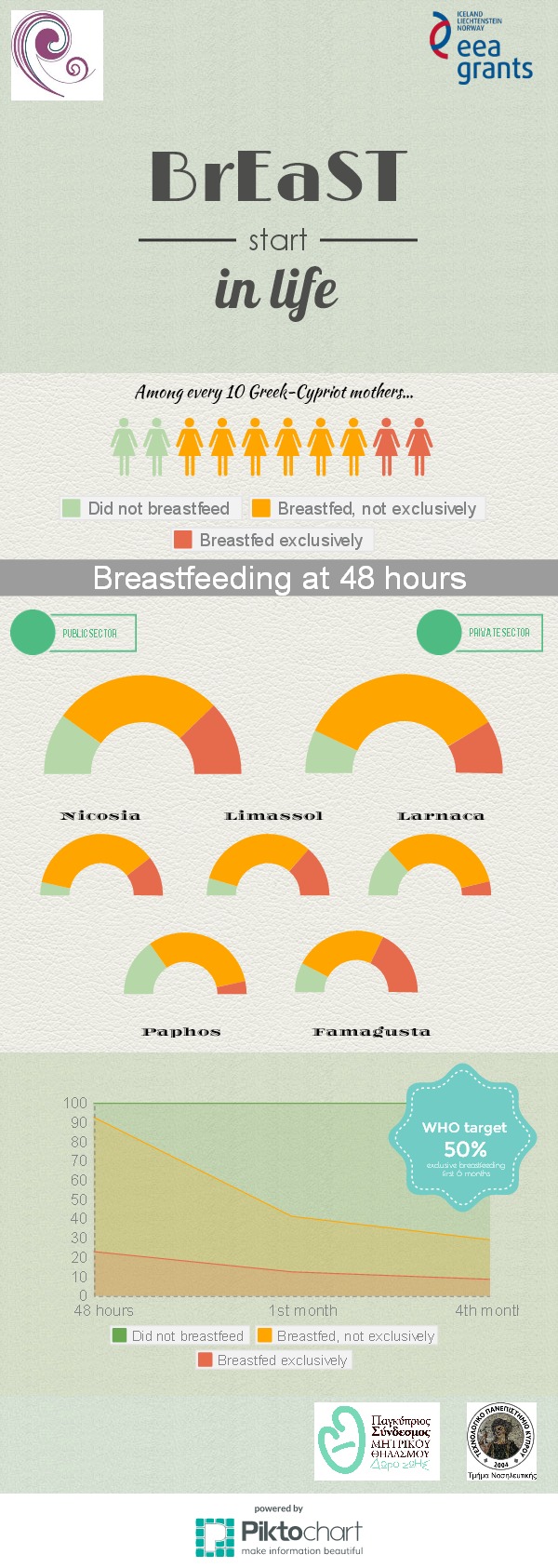
A BrEaST start in life:
Tο ερευνητικό πρόγραμμα «A BrEaST start in life: addressing social inequalities and supporting breastfeeding through inclusion activities» εγκαινιάστηκε τον περασμένο μήνα. Το πρόγραμμα αποτελεί αποτέλεσμα συνεργασίας μεταξύ του Παγκύπριου Συνδέσμου Μητρικού Θηλασμού – «Δώρο Ζωής» (ΜΚΟ) και ερευνητικής ομάδας του Τμήματος Νοσηλευτικής του Τεχνολογικού Πανεπιστημίου Κύπρου. Για περισσότερες πληροφορίες: http://www.breastfeeding-cyprus.org/.
To 18μηνης διάρκειας πρόγραμμα (Απρίλιος 2014 – Οκτώβριος 2015) ωφελείται με το ποσό των €113.000 από επιδότηση από την Ισλανδία, το Λιχτενστάιν και τη Νορβηγία μέσω των επιχορηγήσεων του Ευρωπαϊκού Οικονομικού Χώρου (EEA Grants) και της Κυπριακής Δημοκρατίας Call EEA/CY/NGO/C-1, 2009-2014)."
Σκοπός του προγράμματος είναι η προαγωγή του μητρικού θηλασμού μέσω της γεφύρωση της γνώσης και της πρακτικής σε σχέση με το θηλασμό στη Κύπρο.
Ο κύριοι στόχοι του έργου είναι:
(α) η αξιολόγηση του βαθμού εφαρμογής της πολιτικής των «10 βημάτων» για επιτυχή θηλασμό σε μαιευτικές μονάδες ανά το Παγκύπριο μέσα από τις απόψεις τόσο του προσωπικού των μονάδων όσο και μέσα από την εμπειρία των ίδιων των μητέρων (WP3 - ΤΕΠΑΚ). Τελικός στόχος η αποτύπωση της υφιστάμενης κατάστασης, η εκτίμηση αναγκών και η στοχευμένη προσαρμογή των εκπαιδευτικών δραστηριοτήτων του Παγκύπριου Συνδέσμου Μητρικού Θηλασμού – «Δώρο Ζωής» προς τους επαγγελματίες υγείας και τις θηλάζουσες μητέρες βάσει τεκμηριωμένων ερευνητικών ενδείξεων (WP5 – Σύνδεσμος «Δώρο Ζωής»)
και
(β) η διερεύνηση των πρακτικών και συνηθειών των Κυπρίων μητέρων σε σχέση με το θηλασμό σε βάθος χρόνου, με στόχο την εκτίμηση του ποσοστού έναρξης, της διάρκειας και της αποκλειστικότητας του θηλασμού όπως και η αναγνώριση δυνητικών προσδιοριστικών παραγόντων της πρόωρης διακοπής του, από το μαιευτήριο μέχρι και πέραν των πρώτων έξι μηνών της ζωής του παιδιού (WP4 - ΤΕΠΑΚ). Τελικός στόχος, η ενδυνάμωση και η εξειδίκευση των δραστηριοτήτων εκπαίδευσης, ενημέρωσης, ενεργού εμπλοκής και άλλων δράσεων προώθησης του μητρικού θηλασμού που προσφέρει ο Σύνδεσμος τόσο προς τους επαγγελματίες υγείας, τους εμπλεκόμενους φορείς όσο και προς το κοινό, συμπεριλαμβανομένης της στήριξης ευαίσθητων σε θέματα θηλασμού ομάδων του πληθυσμού και περαιτέρω διευκόλυνσης της πρόσβαση τους στις παρεχόμενες υπηρεσίες του Συνδέσμου. (WP6 – Σύνδεσμος «Δώρο Ζωής»).
Η πολιτική των «10 βημάτων» (WHO/UNICEF «Προστατεύοντας, Προωθώντας και Στηρίζοντας το Μητρικό Θηλασμό, 1989), συμπεριλαμβάνει πρότυπα καλών πρακτικών που στοχεύουν στην επιτυχή εγκαθίδρυση και συνέχιση του μητρικού θηλασμού, των οποίων η αποτελεσματικότητα υποστηρίζεται από πληθώρα ερευνητικών δεδομένων. Αφορούν σε σημαντικές δράσεις για προτροπή των μαιευτικών τμημάτων να συμβάλλουν πρωτίστως στην επιτυχή εγκαθίδρυση του μητρικού θηλασμού, αφού αποτελεί ένα από τους καθοριστικούς παράγοντες για την επιτυχή συνέχιση του. Οι βασικότερες από αυτές τις παρεμβάσεις είναι η διαμόρφωση κατάλληλης πολιτικής, η σωστή εκπαίδευση, η έγκαιρη έναρξη, η δερματική επαφή («skin-to-skin»), η συγκατοίκηση μητέρας-νεογνού («rooming-in»), η ορθή τεχνική, ο θηλασμός σύμφωνα με τη ζήτηση, η αποφυγή συμπληρωματικής τροφής και πιπίλων. Παράλληλα, οι WHO/UNICEF εγκαθίδρυσαν την Διεθνή Πρωτοβουλία «Baby-friendly Hospitals», με βάση της οποίας τα νοσηλευτήρια αξιολογούνται σε συνεχή βάση ως προς τα επίπεδα πρακτικής και συμμόρφωσης τους με τα «10 βήματα» για να τους απονεμηθεί ο τίτλος «Νοσοκομείο Φιλικό προς τα Βρέφη».
Γενική συντονίστρια του προγράμματος είναι η Δρ Ειρήνη Παφίτη-Δημητρίου, Παιδίατρος, Ιδρυτικό Μέλος και Πρόεδρος του Παγκύπριου Συνδέσμου Μητρικού Θηλασμού – «Δώρο Ζωής». Η διεπιστημονική ερευνητική ομάδα αποτελείται από τους πιο κάτω (με αλφαβητική σειρά βάσει επιθέτου) όπως και αριθμό ερευνητικών συνεργατών, μεταπτυχιακών φοιτητών, ερευνητών-πεδίου και πολλών εθελοντών που θα δραστηριοποιηθούν για τους σκοπούς του προγράμματος.
Δρ Κολοκοτρώνη Ουρανία | Παιδίατρος, St. George Medical Programme at the University of Nicosia, Ιδρυτικό Μέλος του ΜΚΟ «Δώρο Ζωής» |
Δρ Κούτα Χριστιάνα | Επ. Καθηγήτρια Κοινοτικής Νοσηλευτικής, Τμήμα Νοσηλευτικής, ΤΕΠΑΚ |
Δρ Λαμπρινού Αικατερίνη | Επ. Καθηγήτρια Παθολογικής Νοσηλευτικής, Τμήμα Νοσηλευτικής, ΤΕΠΑΚ |
Δρ Μίτλεττον Νίκος | Επ. Καθηγητή Μεθοδολογίας της Έρευνας στις Επιστήμες Υγείας & Βιοστατιστικής, Επιστημονικός Υπεύθυνος/Συντονιστής της Ερευνητικής Ομάδας του ΤΕΠΑΚ, Τμήμα Νοσηλευτικής, ΤΕΠΑΚ |
Κα Οικονόμου Μαίρη | Κλινική Διαιτολόγος, Διδακτορική Φοιτήτρια, Τμήμα Νοσηλευτικής, ΤΕΠΑΚ |
Δρ Παφίτη-Δημητρίου Ειρήνη | Παιδίατρος, Ιδρυτικό Μέλος και Πρόεδρος του ΜΚΟ «Δώρο Ζωής», Γενική Συντονίστρια του Προγράμματος |
Κα Παφίτη Ίλια | Σύμβουλος Δημοσίων Σχέσεων, Μέλος του ΜΚΟ «Δώρο Ζωής» |
Κα Τρύφωνος Φρόσω | Επισκέπτρια Υγείας, Μεταπτυχιακό πρόγραμμα «Προηγμένη Νοσηλευτική Πρακτική και Φροντίδα Υγείας στην Κοινότητα», Τμήμα Νοσηλευτικής, ΤΕΠΑΚ |
Δρ Χατζηγεωργίου Ελένη | Μαία, Ειδικό Εκπαιδευτικό Προσωπικό με απόσπαση, Τμήμα Νοσηλευτικής, ΤΕΠΑΚ |
Κα Χατζηιωνά Βασιλική | Μαία, Μεταπτυχιακό πρόγραμμα «Προηγμένη Νοσηλευτική και Φροντίδα Υγείας στην Κοινότητα», Τμήμα Νοσηλευτικής, ΤΕΠΑΚ |
· Τελική έκθεση αποτελεσμάτων του προγράμματος BrEaST start in life
· Εισηγήσεις-Key recommendations
· Ενημερωτικό φυλλάδιο 1 – Εφαρμογή των 10 βημάτων για επιτυχή θηλασμό
· Ενημερωτικό φυλλάδιο 2 – Θηλασμός στην Κύπρο – έναρξη, διάρκεια και αποκλειστικότητα
· Εκστρατεία ενημέρωσης και ευαισθητοποίησης (youtube video)
· 10 βήματα για επιτυχή θηλασμό
· Ημερολόγιο του προγράμματος BrEaST start in life για το 2015 με θέμα το μητρικό θηλασμό
· Δείκτες έναρξης, διάρκειας και αποκλειστικότητας του θηλασμού στην Κύπρο
/Έρευνα/Baby Buddy Forward
Η διαδικτυακή πλατφόρμα Baby Buddy στοχεύει στη χρήση σύγχρονων διαδικτυακών μέσων και μεθόδων προώθησης τεκμηριωμένων πρακτικών και προαγωγής της υγείας των εγκύων και των παιδιών. Συγχρηματοδοτήθηκε από το Ευρωπαϊκό πρόγραμμα Erasmus+ στο πλαίσιο του ερευνητικού προγράμματος “Baby Buddy Forward” με συντονιστή το Τμήμα Νοσηλευτικής, Σχολή Επιστημών Υγείας του Τεχνολογικού Πανεπιστημίου Κύπρου (Επιστημονικός υπεύθυνος έργου: Αν. Καθηγητής Νίκος Μίτλεττον, Κοσμήτορας Σχολής Επιστημών Υγείας) και εταίρους από Κύπρο, Γερμανία, Ελλάδα και Ηνωμένο Βασίλειο. Μπορείτε να δείτε ένα σχετικό βιντεάκι διάρκειας ενάμιση λεπτού εδώ.
Το έργο Baby Buddy Forward έθεσε από την αρχή ως στόχο τη διαμόρφωση της θεματολογίας της πλατφόρμας στο πλαίσιο της Συμμετοχικής Έρευνας Δράσης (Participatory Action Research) και στη βάση των αρχών της διεπιστημονικής συνεργασίας, της συλλογικότητας, της συμμετοχικής δημιουργίας και της συνιδιοκτησίας (περισσότερες πληροφορίες για το έργο, εδώ). ‘Ανω των 700 ατόμων έχουν συμβάλει μέχρι στιγμής σε κάποια από τις δραστηριότητες του Baby Buddy – τόσο επαγγελματίες υγείας, εμπειρογνώμονες όσο και νέοι ή μέλλοντες γονείς. Δημιουργήθηκε πλούσιο έντυπο και οπτικοακουστικό υλικό σε συνεργασία με την Παγκύπρια Γυναικολογική και Μαιευτική Εταιρεία, την Εταιρεία Περιγγεννητικής Ιατρικής Κύπρου, την Παιδιατρική Εταιρεία Κύπρου, την Επιτροπή Μαιών/Μαιευτών του Παγκύπριου Συνδέσμου Νοσηλευτών και Μαιών (ΠΑΣΥΝΜ) και το Υπουργείο Υγείας της Κύπρου (Εθνική Επιτροπή Μητρικού Θηλασμού).
Η πλατφόρμα του Baby Buddy είναι πρωτοποριακή όχι μόνο για τα Κυπριακά αλλά και για τα διεθνή δεδομένα. Αποτελεί χρήσιμο συμπληρωματικό εργαλείο υποστήριξης του εκπαιδευτικού ρόλου των επαγγελματιών υγείας στη φροντίδα μητέρας-παιδιού, ενώ παράλληλα αποτελεί ένα άμεσα προσβάσιμο, ψηφιακό μέσο ενίσχυσης της εγγραμματοσύνης υγείας και προαγωγής της υγείας των εγκύων, των παιδιών και των οικογενειών. Εντάσσεται στο ευρύτερο πλαίσιο της διασφάλισης ίσων ευκαιριών στην πρόσβαση σε πληροφόρηση και συναισθηματική στήριξη κατά τη μετάβαση στο γονεϊκό ρόλο στη βάση των αρχών της «Φροντίδας Υγείας της Μητρότητας με Σεβασμό» του Παγκόσμιου Οργανισμού Υγείας (Respectful Maternity Care) ώστε οι μέλλοντες γονείς να είναι ενδυναμωμένοι και να έχουν τα απαραίτητα εφόδια να διαμορφώσουν ενημερωμένες επιλογές, να συμμετέχουν στη διαδικασία λήψης αποφάσεων για τη δική τους υγεία τους και να αναπτύξουν στάσεις και συμπεριφορές που προάγουν τη σωματική και ψυχική υγεία των ιδίων και της οικογένειας τους.
Χρηματοδότηση: Erasmus+: «Εκπαίδευση Ενηλίκων».
Συντονιστής έργου: Τμήμα Νοσηλευτικής, Σχολή Επιστημών Υγείας, ΤΕΠΑΚ.
Εταίροι:
· Best Beginnings (UK)
· Birth Forward (Κύπρος)
· Πανεπιστήμιο Δυτικής Αττικής (Ελλάδα)
· Cosmoanalixis (Ελλάδα)
· Protestant University of Applied Sciences, Berlin (Γερμανία)
Συνεργαζόμενοι φορείς:
· Υπουργείο Υγείας Κύπρου
· Παγκύπρια Μαιευτική και Γυναικολογική Εταιρεία
· Εταιρεία Περιγεννητικής Ιατρικής Κύπρου
· Παιδιατρική Εταιρεία Κύπρου
· Επιτροπή Μαιών, Παγκύπριου Συνδέσμου Νοσηλευτών και Μαιών (ΠΑΣΥΝΜ)
Τί είναι το Baby Buddy Forward? FILE
What is Baby Buddy Forward? FILE
Έρευνα/Center for Translational Research in Health Care “BRIDGES”
Center for Translational Research in Health Care “BRIDGES”
Scientific findings from basic laboratory, clinical, or population studies need to be transformed into new clinical tools, processes, or applications which is the function of a rapidly expanding field of science known as ‘‘translational research”. The intent is to build the bridge from ‘‘bench to bedside’’ so that the initial discovery gains acceptance and makes an impact on healthcare practice, policy, and economics at local and national levels. The translation of research findings into practice is a major challenge to health care systems worldwide. This failure, to use new knowledge and evidence, is costly, harmful, and results in ineffective care being delivered to the public.
The Center for Translational Research in Health Care “BRIDGES”, housed within the Department of Nursing at the Cyprus University of Technology, is a first-of-its-kind, innovative model for advancing safe, effective, evidence-based patient and family care. “BRIDGES” sets out to create an infrastructure that inspires partnerships between higher education, healthcare institutions, community care facilities, patient advocacy organizations and industry seeking to accelerate the translation of innovations into clinical practice and to increase patients’ benefit from research.
Maria Kyranou, Assistant Professor at the Department of Nursing, is the Head of “BRIDGES” and initiated its development in September 2020, with financial support by the Cyprus University of Technology. Dr Kyranou is deeply committed to translating scientific findings pertinent to nursing science and collaborating with other parties to implement findings into everyday clinical practice. Her long-term clinical experience along with her involvement in similar projects in pragmatic clinical settings drive her confidence and enthusiasm about “BRIDGES”.
Guiding Principles
“BRIDGES”, the Center for Translational Research in Health Care is committed to:
· Initiating and supporting research that advances safe and effective, evidence-based care.
· Designing strategies to promote the development, use, and translation of evidence into practice.
· Assuming leadership for innovation in evidence-based practice in health care.
· Promoting interdisciplinary team learning, practice and research to optimize safe, effective patient and family care.
· Involving patients and the public in the development and evaluation of individual, group and organizational programs of research.
· Providing leadership for innovations for clinicians, patients and families in learning.
· Fostering an environment of clinical inquiry and experiential learning.
· Developing new collaborative opportunities across disciplines.
· Generating new partnerships and multiple funding opportunities to advance the work of the Center and the University.
· Disseminating the work of the Center/University through multiple local, national, and international bodies.
/Έρευνα/TRANSiTION Project
Project Description
Empowering the Cancer Workforce with New Digital Skills
The TRANSiTION project will develop an advanced education programme for healthcare professionals and non-clinical staff (i.e. health managers), equipping them with digital skills needed to exchange information more efficiently and effectively with patients and other professionals. The project will begin by assessing and mapping the current digital skills and will engage directly with stakeholders to identify their specific needs. This will enable and facilitate professionals and non-clinical staff to adopt new digital tools and integrate them into their everyday practices enabling a smoother digital transition.
Led by the Cyprus University of Technology (CUT), the project collaborates with various organisations and uses a problem-solving, teamwork approach to enhance competencies. TRANSiTION has a consortium of 25 partners from 14 member states with expertise in professional development and training programmes in the healthcare sector.
Official Website Link
https://www.europeancancer.org/eu-projects/resource/transition
Impact
The TRANSiTION education programme addresses the immediate needs of healthcare professionals and non-clinical staff while building a digital culture that is sustainable and adaptable to future opportunities for better cancer care across Europe.
This project will target three groups:
- Clinical professionals in general medicine, medical oncology, radiation oncology, surgical oncology, and cancer nurses.
- Non-clinical professionals working on health planning, procurement and management.
- Patients
Find below a summary of how the TRANSiTION project will impact each target group.
Innovation
The project drives change and innovation in the health sector by identifying and optimising digital technologies for clinical and non-clinical professionals. It addresses challenges in deploying these technologies in cancer care, and enhancing the readiness of healthcare professionals to utilise digital solutions available today and in the future. This contributes to the resilience of health systems while developing skills for recovery from the COVID-19 pandemic and future crises.
Kickoff Meeting
The project held its official kick-off event on 4-5 May 2023 in Limassol, Cyprus, under the leadership of Prof. Andreas Charalambous, president of European Cancer Organisation and project coordinator for the TRANSiTION Project.
Consortium
TECHNOLOGIKO PANEPISTIMIO KYPROU (CUT) |
EUROPEAN CANCER PATIENT COALITION (ECPC) |
EUROPEAN ONCOLOGY NURSING SOCIETY (EONS) |
SERVIZO GALEGO DE SAUDE (SERGAS) |
FUNDACION BIOMEDICA GALICIA SUR |
EUROPEAN CANCER ORGANISATION (ECO) |
SVEUCILISTE JOSIPA JURJA STROSSMAYERA U OSIJEKU MEDICINSKI FAKULTET OS IJEK (MEFOS) |
KLINICKI BOLNICKI CENTAR SPLIT (KBC SPLIT) |
PADAGOGISCHE HOCHSCHULE HEIDELBERG (PHHD) |
ASSOCIACAO DE INVESTIGACAO DE CUIDADOS DE SUPORTE EM ONCOLOGIA (AICSO) |
MITROPOLITIKO COLLEGE ANOYMI EKPAIDEYTIKI ETAIRIA (MITROPOLITIKO) |
LINAC-PET SCAN OPCO LIMITED (GOC) |
NACIONALINIS VEZIO INSTITUTAS (NCI) |
PCG POLSKA SP (ZOO) (PCG Polska) |
UNIVERSITAETSKLINIKUM FREIBURG (UKLFR) |
VSI SMART HEALTH DIH (Health DIH) |
INSTITUTUL ONCOLOGIC PROF DR ION CHIRICUTA CLUJ-NAPOCA (IOCN) |
INSTITUTO EUROPEO DI ONCOLOGIA SRL (IEO) |
EUROPEAN HEALTH MANAGEMENT ASSOCIATION (EHMA) |
UNIVERSITE DE BRETAGNE OCCIDENTALE (UBO) |
UNIVERSITATEA DE MEDICINA SI FARMACIE CAROL DAVILA DIN BUCURESTI (UMFCD Bucharest) |
WELLICS EFARMOGES EREVNAS KAI PLIROFORIKIS MONOPROSOPI I.K.E. (WELLICS) |
FUNDACIO PER A LA UNIVERSITAT OBERTA DE CATALUNYA (FUOC) |
BULGARIAN GENERAL PRACTICE SOCIETY FOR RESEARCH AND EDUCATION (BGPSRE) |
UNIVERZA V MARIBORU (UM) |
INSTITUT CATALA D'ONCOLOGIA (ICO) |
FUNDACION BIOMEDICA GALICIA SUR |
Recruitment
"Enhance Your #Oncology Expertise with #TRANSiTION!
Join our EU Co-funded programme to boost your digital skills. We are actively recruiting both trainers and trainees to play crucial roles:
· Trainers: Participate in the Training of Trainers module, preparing you to support and guide trainees.
· Trainees: Join the training programme, enhancing your skills to deliver high-quality oncology care.
Application deadline extended until September 2025. Free and accredited training for all participants!
Apply now: https://www.europeancancer.org/eu-projects/resource/transition
/Έρευνα/Co - Operator
Welcome to the website of coOPERATOR. This innovative Horizon EU4Health project aims in developing a Country-Observatory for sharing best practices for vaccination promotion.
Έρευνα/Co - Operator/About
Developing a Country-Observatory to share best practices for vaccination promotion. co-OPERATOR is a Horizon EU4Helath funded project that runs from November 2023 to October 2026.
European stakeholders face significant variability in addressing vaccination hesitancy and implementing COVID-19 vaccination campaigns among healthcare providers and the general population. Challenges include widespread hesitancy within the population and variations in the communication skills of healthcare providers. To address these issues, cross-country initiatives play a crucial role in knowledge-sharing, especially considering the observed differences in vaccine coverage during the COVID-19 pandemic.
The co-OPERATOR project seeks to capitalize on research findings by developing and piloting a knowledge hub, virtual observatory, and training system across participating countries and beyond. This proof-of-concept initiative aims to gather, structure, and disseminate knowledge, best practices, and resources related to stakeholders’ strategies for COVID-19 vaccination and beyond. The primary focus lies in advancing communication and knowledge skills while addressing systemic barriers and facilitators for effectively promoting vaccination messages to the population.
/Έρευνα/Co - Operator/Objectives
Objectives
Objective 1
To build survey tools to measure the determinants of vaccine uptake (general population) and of skills for promoting vaccination programmes efficiently (healthcare professionals).
Objective 2
To develop a set of citizen-centred evidence- based, scientifically sound recommendations and advice on how to address low vaccination uptake and to help healthcare professionals communicating more efficiently about vaccines.
Objective 3
To provide a comprehensive assessment of factors underlying low vaccination uptake and healthcare professionals’ barriers and facilitators to communicate vaccination information as well as their distribution among target population groups to inform a citizen-centered approach to promote vaccination uptake.
Objective 4
To design and develop an intuitive and interactive virtual observatory (the co-OPERATOR platform) to foster dissemination, transferability, utilization of project results across the participating member states, the EU/EEA and beyond.
Objective 5
To translate research evidence generated by other WPs into evidence-based recommendations (intervention toolset) by engaging with stakeholders through a Policy Lab to address barriers and knowledge gaps and co-create practical solutions for implementation at regional, national, and European level.
Έρευνα/Co - Operator/Partnership
Partnership
The consortium engaged in this project conducted research that uncovered (a) differing success levels in conveying vaccination messages to the population, underscoring the need to enhance stakeholders' capabilities in vaccination promotion, and (b) the intricate nature of vaccination hesitancy, necessitating collaboration across diverse entities, ranging from healthcare professionals to local governments.
Project Coordinator: Cyprus University of Technology (CUT)
Cyprus University of Technology (CUT) is state university in Cyprus which was founded by law in 2004 and accepted its first students in September 2007. CUT research and academic staff is involved in more than 340 projects with a total funding/ contribution over 50m euro and is the second largest and one of the leading research Universities in Cyprus, that has high values regarding its academic character and its emphasis on high quality research in major branches of science and technology. It has a staff of approximately 300 academics, approximately 400 Researchers and Special Scientists, and 219 administrative employees supporting all aspects of teaching and research. Research emphasis at CUT is reflected in the substantial funding provided to academics for the establishment of research centres and laboratories, the support it provides for collaborations with world renowned Universities and Institutions, and the participation of its faculty in several national and European research projects. The research projects are funded under the HORIZON2020, the FP7, the ERASMUS+ and Lifelong Learning Programme, the National Framework Programmes of the Cyprus Research Promotion Foundation, the European Territorial Cooperation Programmes (INTERREG), the COST Programme, the LIFE+, the EUROSTARS, EU4Health etc.
Nursing department at Cyprus University of Technology
The Department of Nursing is nested within the School of Health Sciences and offers undergraduate and postgraduate degrees in nursing and midwifery. In addition, the Department has a PhD program and a wide range of collaborations with research, policymaking and clinical institutions in Cyprus and abroad.
The Department is research-active and is the highest-ranked Nursing Department in Cyprus. The Behavioral Science in Health research lab is a newly established centre within the Department that promotes inter-disciplinarily in the area of public health. The project is nested within this research group that includes a range of experts in public health, epidemiology, medicine, nursing, psychology and biostatistics among others.
Beneficiaries
CSI, CENTER FOR SOCIAL INNOVATION LTD
The Centre for Social Innovation (CSI) is a Research and Development organization which focuses on
fostering social innovation that can bring about a positive change to local, national, regional, and global contexts. CSI belief, is that the four pillars of Social Interaction, Education, Development and Economic Rationalization coupled with fundamentally sound and sustainable solutions as well as disruption to streamlined solutions to systemic social problems can lead to creative solutions that impact significant change to the social fabric of every society. CSI is working closely to address market, social, economic and cultural challenges with governments, local administrative agencies, non-for-profit agencies, commercial entities, and educational institutions. We identify and address systemic challenges through evidence-based research, state of the art investigation of global, national, regional and local solutions, developing solutions by taking into consideration the local ecosystem, cultural dynamics, meet the stakeholders needs and implementing those solutions as we keep constant vigilance to ensure continual feedback loop and adjustments. The feedback mechanisms and processes we employ allow us certainty in keeping in touch with our stakeholders and continually update our social solutions proposition. CSI team is composed of more than 30 open-minded, fully equipped researchers, educators, VET Trainers, social entrepreneurs, project managers, trainers, and Information Technology Developers. CSI encompasses the capability and capacity to identify social needs, design and implement adjusted initiatives and project and provide for sustainable growth, based on its extensive expertise in successfully completing more than 100 funded projects. CSI is focus on the improvement of the Quality of Life for all and leverages Social Innovation to attain Social Justice, to solve Systemic Challenges and develop solutions that may provide opportunities for individuals and organizations. CSI has years of experience in participating and coordinating European projects.
MS, MINISTERIO DA SAUDE – REPUBLICA PORTUGUESA
DGS is a central service of the Ministry of Health that regulate, guide and coordinate health promotion and disease prevention activities; define technical conditions for healthcare provision; plan the national policy for health system quality; and prepare and execute the National Health Plan. It is headed by Director General of Health, assisted by two Deputy Directors General of Health, and includes 4 service directorates, 9 divisions, 2 multidisciplinary units and 12 priority health programmes.
UNIPI-UNIVERSITA DI PISA
Department of Translational Research and New technologies in Medicine and Surgery. Founded in 1343, the University of Pisa is one of the oldest universities of Europe. The University of Pisa is a public institution with twenty departments, and high level research centres in the agriculture, astrophysics, computer science, engineering, medicine and veterinary medicine sectors. Among its glories is Galileo Galilei, who was born and studied in Pisa and became professor of mathematics in 1589.
CSSA-COMPUTER SOLUTIONS ANONYMI VIOMICHANIKI KAI EMPORIKI ETAIREIA PLIROFORIKIS
Computer Solutions S.A. (CSSA) was founded in Athens in 1987, as a result of the cooperation of experts in the fields of Information Technology and the Health Care Sector. CSSA is one of the leading Health IT solution providers in Greece, a software house with more than 30 years of experience in the field of Information Technology by developing Products, implementing Solutions, delivering Projects and offering Services to meet the needs and expectations of their customers (more than 30 public Hospitals and more than 100 private ventures) and partners. It has been able to develop and support large scale IT projects and Web/ Cloud solutions with an agile mindset and methodology, cutting-edge technologies, full standards compliance, as well as state-of-the-art interoperability through a robust HL7/FHIR/SOA platform.
CSSA’s portfolio consists of many successful software products, including a complete IHIS platform (ASCLEPIOS™ HOSPITAL) that covers all functional areas of a modern Health Care institution and a mature cloud Personal Health Record (MedIndoBook™ for web, Android® and iOS®). It’s ongoing Research & Development (R&D) projects mainly focus on the areas of Artificial Intelligence (A.I.), Machine Learning, Big Data Analysis & Administration, Chronic Disease Monitoring, Biosignals and Computer Vision & Image Processing, Distributed Networks and Safety/Data Security-Privacy.
CESIE
CESIE is a European centre of studies and initiatives established in 2001 with a mission to promote educational innovation, participation and growth. CESIE involves people, society, the private and public sector to research and test educational methodologies that respond to social needs. The NGO has a strong expertise in the field of social engagement: the team is active in the field of employability promotion and social inclusion of disadvantaged groups (e.g., people with a migrant background and from ethnic minorities, disabled people, people living in socio-cultural disadvantage, etc.) on a daily basis. Finally, CESIE has expertise in management and coordination of several projects focusing on innovative methodologies to increase civic, social, cultural and economic participation. As such, CESIE can count on solid networks of youth organisations and policy-makers, both at local and EU level. The coOPERATOR project is managed by the Higher Education and Research Unit.
ACN-ASSOCIAZIONE CITTADINANZATTIVA ONLUS
Cittadinanzattiva APS is an organization, founded in Italy in 1978, which promotes citizens’ activism for the protection of rights, the care of common goods, the support for people in conditions of weakness in Italy and abroad.
Our mission refers to article 118, last paragraph of the Italian Constitution, proposed by us and implemented in the constitutional reform of 2001. Article 118 recognizes the autonomous initiative of citizens, individuals and associates, for carrying out activities of common interest and, based on the principle of subsidiarity, provides for the obligation of institutions to favor active citizens.
Cittadinanzattiva, which has also been officially recognized in Italy as a consumer organization since 2000, is independent from any political affiliation, trade unions, private companies, and public institutions.
Cittadinanzattiva considers citizens a fundamental resource for democracy, who play an active role in society and should have the opportunity to participate in everyday policy making.
As the European interface of Cittadinanzattiva, Active Citizenship Network operates in coherence with Cittadinanzattiva’s mission. It is therefore deeply involved and active, both at the European level and across EU Member States, to increase the promotion of civic activism and participation in the political arena, and to better protect citizens’ rights, which are both the strength and the uniqueness of ACN.
EFPC-EUROPEAN FORUM FOR PRIMARY CARE
The European Forum for Primary Care was initiated in early 2005 by a group of interested parties from several countries. The aim of the Forum is to improve the health of the population by promoting strong Primary Care. This is done by advocating for Primary Care, by generating data and evidence on Primary Care and by exchanging information between its members. The Forum seeks to expand its membership and thereby to become a leading force for strengthening Primary Care in Europe.
UM-UNIVERSITEIT MAASTRICHT
Maastricht University (UM) is the most international university in the Netherlands and, with nearly 22,000 students and 4,400 employees, is still growing. The university distinguishes itself with its innovative education model, international character and multidisciplinary approach to research and education.
Thanks to its high-quality research and education, as well as a strong focus on social engagement, UM has quickly built a solid reputation. Today, it is considered one of the best young universities in the world.
(taken from website)
Our research institute:
CAPHRI: Care and Public Health Research Institute
Our aim is to create a healthy society for everyone. We are doing this by providing high quality research to improve the individual quality of life and innovate healthcare and public health. Building a bridge between our research and society has our highest priority.
Radboudumc STICHTING RADBOUD UNIVERSITAIR MEDISCH CENTRUM
Stichting Radboud Universitair Medisch Centrum (Radboudumc or RUMC) is a leading academic centre for medical science, education and health care. Knowledge forms the heart of the organisation, connecting research, education and patient care.
/Έρευνα/Co - Operator/Work Packages
Work Packages
Work Package 1
Project management and coordination
Task Leader: CUT / Duration: 36 months
Work Package Description
WP1 is led by Cyprus University of Technology (CUT) and entails project management and coordination, overseeing the planning of the overall financial and administrative project organization and activities.
Work Package 2
Dissemination and Sustainability Strategies
Task Leader: CSI / Duration: 36 months
Work Package Description
WP2 is led by Center for Social Innovation (CSI) and entails the dissemination and the sustainability strategies of the project.
Work Package 3
Virtual platform/Observatory and AI
Task Leader: CSSA / Duration: 30 months
Work Package Description
WP3 is led by Computer Solutions S.A (CSSA) and entails the design of the virtual observatory and co-OPERATOR platform. The focus of WP3 is on developing training tools and online platforms to facilitate the dissemination of knowledge with aim to increase vaccine uptake and vaccine literacy among participating countries and will support decision-makers, experts, and EU citizens to understand the determinants of vaccine uptake and healthcare professionals’ barriers and facilitators of promoting vaccine information.
Work Package 4
Understanding and Preparing
Task Leader: UNIPI / Duration: 24 months
Work Package Description
WP4 is led by University of Pisa (UNIPA) and entails tasks for advancing communication and knowledge skills while addressing systemic barriers and facilitators for effectively promoting vaccination messages to the population.
Work Package 5
Mapping, Research and Implementation
Task Leader: CUT / Duration: 18 months
Work Package Description
WP5 is led by Cyprus University of Technology (CUT) and entails the mapping, the research, and the implementation of research activities.
Work Package 6
Translate research evidence to policy recommendations
Task Leader: UM / Duration: 36 months
Work Package Description
WP6 is led by Maastricht University (MU) and entails the capacity building within local communities and civil society stakeholders structured online courses and face-to-face workshops. Additionally, this WP aims to translate evidence generated in WP3 to WP5 to develop advice on addressing challenges and scaling up COVID-19 vaccination efforts through a Policy Lab. This platform facilitates the sharing of best practices among participating countries, mapping barriers and facilitators to mass vaccination using data from WP4 and WP5.
/Έρευνα/Co - Operator/News
Newsletters
News Items & Stories
/Έρευνα/OPENCARE Project
Background and general objectives
The overall aim of the OpenCare initiative is to address gender stereotypes by encouraging the involvement of men in formal long-term care (LTC) work. This not only promotes gender equality but also contributes to increasing the availability of LTC services by responding to the current shortage of care staff. Tackling this shortage is essential for supporting work-life balance for both men and women.
OpenCare seeks to challenge the barriers men face in accessing and staying in LTC roles, while actively working to make the sector more inclusive and representative.
Get Involved!
Want to follow the project, use our materials, or join an event?
We’d love to hear from you!
➡️ Contact your country’s partner: Cyprus University of Technology (CUT)
Tsitsi Theologia (Scientific Coordinator)
theologia.tsitsi@cut.ac.cy
➡️ Follow us on Facebook and LinkedIn.
Disclaimer
Funded by the European Union. Views and opinions expressed are those of the author(s) only and do not necessarily reflect those of the European Union or the European Education and Culture Executive Agency (EACEA). Neither the European Union nor EACEA can be held responsible for them.
Mission
To promote gender-inclusive caregiving professions by addressing stereotypes and stigma around male carers, while contributing to workforce sustainability in the long-term care sector across Europe.
Get Involved!
Want to follow the project, use our materials, or join an event?
We’d love to hear from you!
➡️ Contact your country’s partner: Cyprus University of Technology (CUT)
Tsitsi Theologia (Scientific Coordinator)
theologia.tsitsi@cut.ac.cy
➡️ Follow us on Facebook and LinkedIn.
Disclaimer
Funded by the European Union. Views and opinions expressed are those of the author(s) only and do not necessarily reflect those of the European Union or the European Education and Culture Executive Agency (EACEA). Neither the European Union nor EACEA can be held responsible for them.
Specific Objectives
· Challenge stereotypes, stigma, and discrimination related to male carers.
· Encourage and support men in pursuing and remaining in long-term care careers.
· Help address the workforce shortage in the LTC sector.
· Contribute to gender equality and improved work-life balance.
· Raise awareness through tools and resources that support inclusive recruitment in care.
Consortium set-up
The OpenCare project brings together a transnational consortium of six organizations from five European countries, each with expertise in social innovation, care, and inclusion:
Coordinator
Anziani e non solo, Italy
Partners
AFEJI, France
Cyprus University of Technology, Cyprus
Aproximar, Portugal
European Association for Social Innovation, Romania
The Portuguese Association for Diversity and Inclusion (APPDI), Portugal
Concept and methodology
OpenCare is built on the premise that increasing male participation in care work requires more than recruitment—it demands cultural and structural change. The project will combine research, awareness, education, and practical support tools.
Methodology includes:
· A European study and whitepaper on male carers and gendered stereotypes
· Development of the OpenCare methodology
· Awareness workshops and a guide to breaking stereotypes
· A practical toolkit to help open LTC careers to men
· Activities will be implemented through a collaborative and participatory approach across the partner countries.
Project Team
The project is delivered by a multidisciplinary team of researchers, practitioners, educators, and policy experts from the fields of social care, gender equality, and workforce development. Each partner contributes national insight and practical experience to support transnational learning and local adaptation.
Work Packages (WPs)
WP1: Research & Whitepaper
· Investigate the stereotypes and stigma around male carers
· Produce a European whitepaper summarizing findings
WP2: Methodology Development
· Design the OpenCare methodology based on research results
WP3: Awareness and Education
· Develop workshop materials and an Awareness Guide
· Engage stakeholders through training and awareness events
WP4: Career Support Toolkit
· Create a toolkit to promote male recruitment and career entry in LTC
· Include guidance for employers, training centers, and job seekers
WP5: Communication and Dissemination
· Share outcomes through digital platforms (Facebook, LinkedIn)
· Promote public and institutional awareness across Europe
Project Impact
The project aims to:
· Reduce stigma and barriers for male carers
· Increase the number of men entering and remaining in the LTC workforce
· Promote work-life balance through expanded care availability
· Encourage systemic change through awareness and training
· Equip institutions and employers with tools to foster inclusivity
Expected Results:
· A European whitepaper on gender stereotypes in LTC
· OpenCare methodology for inclusive recruitment
· Awareness Guide and training materials
· Toolkit for supporting male careers in care
Contact
Tsitsi Theologia
theologia.tsitsi@cut.ac.cy
Duration
01/01/2025 – 31/12/2026 (24 months)
Internal Funding
Internal Fundings
Internal funding
|
|
Project title: | A critical examination of the development of postgraduate level clinical competencies for critical care nurses |
Aims/Objectives: | To develop a critical nurses competencies questionnaire |
Funding body: | Cyprus University of Technology (internal funding) |
Amount: | €25000 |
Period: | 2008 - 2010 |
Team: | E. Papastavrou (PI), M. Hadjimbalassi (main researcher), E. Athini, E. Lambrinou, E. Georgiou, A. Merkouris
|
Project title: | Identify and evaluate sexual and reproductive health needs of female migrant domestic workers. |
Funding body: | Cyprus University of Technology (internal funding) |
Amount: | £5000 CY |
Period: | 2007-2008 |
Team: | C. Kouta (PI), A. Zoe |
|
|
Start-up funding
Project title: |
Evaluation of the community nursing care of the elderly in Cyprus. |
Aims/Objectives: | Evaluate the community nursing care, particularly home care of the elderly in Cyprus |
Funding Body: | Cyprus University of Technology |
Amount: Period: Team: | 50.000 CYP 2007-2011 C.Kouta (PI), C. Kaite
|
Project title: | The Care Project" http://www.cut.ac.cy/careProject/"The concept of care giving behaviours as perceived by nurses and patients. |
Aims/Objectives:
Amount: Period: | An international study aiming to explore patients and nurses perception about caring behaviours, individualized care and satisfaction from care. 50.000 CYP 2008-2011 |
Funding body: | Cyprus University of Technology (start-up grant) |
Team: | Finland, University of Turku (R. Suhonen, H. Leino-Kilpi) Greece, National and Kapodistrian University of Athens (E. Patiraki, C. Karlou) Hungary, the Semmelweis University (Z. Balogh) Italy, the University of Udine (P. Tomietto) Czech Republic, the University of Ostrava (D. Jarosova). Researcher in charge: E. Papastavrou, Cyprus Technology University, School of Health Sciences, Department of Nursing |
Project title: | Management of patients with HF using Education, Education and Telephone follow-up and Telephone follow up only in Cyprus (MEETinCY) |
Amount: Period: | €85.430 2008-2011 |
Funding body: | Cyprus University of Technology (start-up grant) |
Team: | E. Lambrinou (PI), Middleton N (CUT), Papathanassoglou EDE (CUT), Kalogirou F (CUT), Lamnisos D (CUT), Lemonidou C (Univ Athens), Sourtzi P (Univ Athens) |
|
|
Project title: | Development of an instrument to measure patient satisfaction with hospital care in Cyprus. |
Aims/Objectives: | To develop a valid, reliable and standardized instrument as well as methodology to measure patient satisfaction with hospital care in Cyprus. |
Funding body: | Cyprus University of Technology (start-up grant) |
Amount: | €75.000 |
Period: Team: | 2008-2011 Merkouris, A. (P.I). A. Andreadou (special scientist), E.Athini (CUT), M. Hadjimbalasi (CUT), M. Rovinthis (TEI of Crete), E. Papastavrou (CUT), E. Patiraki (UoA), C. Lemonidou (UoA). |
|
|
Project title: | Development of the behavioral surveillance system of HIV/AIDS and HCV in Cyprus. |
Aims/Objectives: | The aim of the project was to estimate the prevalence of HIV and HCV infection in Men who have Sex with other Men (MSM), Intravenous Drug Users (IDUs) and prisoners as well as to address the high risk behaviours that increase the risk for HIV and HCV transmission. |
Funding body: | Cyprus University of Technology (start-up grant) |
Amount: | € 80,000 |
Period: | 2008-2010 |
Team: | V. Raftopoulos (PI) |
Project title: | Anxiety symptoms and immunity. |
Aims/Objectives: | The aim of this project was the exploration of the associations between anxiety symptoms and i) lymphocyte counts, ii) lymphocyte expression of Fas & Fas ligand (FasL). A descriptive correlational single measurement design was applied in a convenience sample of 39 ICU nurses. |
Funding body: | Cyprus University of Technology (start up grant) |
Amount: | € 25,000 |
Period: | 2009-2011 |
Team: | E Papathanassoglou (PI). Other members of team: M Karanikola, M Mpouzika. |
|
|
Project title: | Development of capacity and infrastructure for the investigation of geographical health and socio-economic disparities across Cypriot communities |
Aims/Objectives: | Develop infrastructure (i.e. GIS) and capacity (including training) in order to effectively use routine sources of data (mortality, morbidity, cancer registries and census) in the context of the first-time mapping and investigation into the magnitude and determinants of geographical health and social inequalities across communities in Cyprus. |
Funding body: | Cyprus University of Technology (start-up grant) |
Amount: | € 80,000 |
Period: | 2010-2013 |
Team: | N. Middleton (PI). Other members of core team:D. Lamnisos (post-doctoral fellow), G. Zannoupas (PhD candidate), P. Ellina (MSc candidate). |
Project title: | Primary Prevention and Mental Health Care in the Community. |
Aims/Objectives: | This project is about the influence of the mental health care milieu on the psychological response of both the Greek- Cypriot Psychiatric-Mental Health Nurses (PMHNs) and their patients. This project has been completed in three parts. The first part regarded the quantitative exploration of PMHNs professional attitudes and associations with mental health factors. The second part was about the phenomenological exploration of the lived experience of Greek-Cypriot PMHN of their role. The third part of the project, called the PHENOMIC study, regarded the phenomenological exploration of the lived experience of mentally ill patients. Special focus has been given to the way they interpret their illness and their relationships with nurses. |
Funding body: | Cyprus University of Technology (start-up grant) |
Amount: | € 80,000 |
Period: | 2009-2014 |
Team: | M. Karanikola (PI). Other: F. Vouzavali (post-doctoral fellow), C. Kaite (PhD candidate), E. Kaikoushi, A. Hadjioannou (MSc candidates), A. Koutroubas (researcher fellow), E. Papathanassoglou. |
Project title:
| The use of Guided Imagery and Progressive Muscle Relaxation techniques in Patients with Prostate or Breast Cancer as a means to cluster symptom management (Quantitative Study). |
Funding Body: | Cyprus University of Technology (start-up grant) |
Amount: | € 21.000 |
Period: | 2010-2015 |
Team: | Charalambous A. (PI) |
|
|
Project title: | Clinical Trial of a psychological support intervention on patient outcomes neuropeptidic and immunological measures in critically ill patients. |
Funding Body: | Cyprus University of Technology (start-up grant) |
Amount: | €80.000 |
Period: | 2010-2013 |
Team: | E. Papathanassoglou (PI). |
| |
Project title: | A randomized control trial (feasibility study) in collaboration with the University of Manchester for the use of Inspirational Muscle Training in patients with lung cancer suffering from breathlenesess (Co-researcher, partly funded). |
Funding Body: | Cyprus University of Technology |
Amount: Period: Team: | €13000 2012-2015 A. Charalambous (PI), Dr H. Charalambous, Dr N. Dekatris, M. Stavrinou, M. Fanti (Research Associates).
|
Project title: | Chronic pain in survivors of critical illness |
Aims/Objectives: | The aim of the project is to describe the intensity and characteristics of pain in a sample of critically ill patients within one year after leaving the ICU, and investigate correlations with treatment parameters and demographic characteristics. |
Funding Body: | Cyprus University of Technology |
Amount: Period: Team: | €40.000 (start-up grant) 2016- M. Mpouzika (PI) |
|
|
Project title: | Centre of Education and Research on Trauma Care (CERTC): Establishment and Initial Project Management. |
Aims/Objectives: | The CERTC will promote the training on the management and treatment of critically wounded casualty during transport, in-hospital, in prehospital, or in remote setting in Cyprus and worldwide. It aims in attracting students at an international scale level to provide specialized advanced training in trauma. CERTC students are physicians, nurses, paramedics and other health care professionals with high interest in the management and treatment of critically wounded casualty |
Funding Body: | Cyprus University of Technology |
Amount: Period: Team: | €40.000 2016- Sarafis, P. (PI) |
Research Activity
| |
Project title: | The students' learning environment in the clinical area. |
Aims/Objectives: | An initial exploration of hospitals as learning environments for students of nursing |
Funding body: | Cyprus University of Technology (research activity grants) |
Amount: | 3000 CYP |
Period: | Period: 2007-2008 |
Team: | E. Papastavrou (PI), E. Lambrinou, M. Saarikoski |
|
|
Project title: | The burden of family care of patients with schizophrenia. |
Aims/Objectives: | To explore care giver burden of patients with schizophrenia |
Funding body: | Cyprus University of Technology (research activity grants) |
Amount: | 3000 CYP |
Period: | 2007 - 2008 |
Team: | E. Papastavrou (PI), G. Karayiannis |
|
|
Project title: | The student’s learning environment in the clinical area. |
Aims/Objectives: | An initial exploration of hospitals as learning environments for students of nursing. |
Funding body: | Cyprus University of Technology (research activity grants) |
Amount: | 3000 CYP |
Period: | 2007 - 2008 |
Team: | E. Papastavrou (PI), E. Lambrinou, M. Saarikoski |
|
|
Project title: | The burden of family care of patients with cancer. |
Aims/Objectives: | To explore care giver burden of patients with cancer |
Funding body: | Cyprus University of Technology (research activity grants) |
Amount: | 3000 CYP |
Period: | 2008 - 2010 |
Team: | E. Papastavrou (PI), A. Charalambous |
|
|
Project title:
Aims/Objectives:
Funding body: Amount: Period:
Team: | Professional interactions and mild psychiatric symptoms in critical & oncology care nurses. The primary aim of this project was the exploration of the association between mild psychiatric symptoms and nurse-to-nurse & nurse-to-physician quality of interactions. This was a descriptive correlational design, involving a random sample of 229 Greek ICU nurses, 78 oncology and 187 emergency care nurses. Cyprus University of Technology (research activity grants) € 1,500 2008-2010 M. Karanikola (Principal investigator). Other members of team: M. Kalafati (post doctoral fellows), H. Stathopoulou (research fellow), E. Papathanassoglou, M. Mpouzika. |
Project title: | Workplace and neighborhood social capital: a validation and correlational study with self-rated health and psychological distress among Cypriot nurses. |
Aims/Objectives: | To assess the construct validity of the Workplace Social Capital questionnaire (originally used in the Finish Public Sector study) and the Onyx and Bullen’s Social Capital Questionnaire (originally used in South Wales Australia) as well as investigate association with self-rated health and psychological distress among Cypriot nurses |
Funding body: | Cyprus University of Technology (research activity grants) |
Amount: | €2.000 |
Period: | 2009-2011 |
Team: | N. Middleton (PI). Other members of team: M. Karanikola, C. Kouta, E. Papastavrou. |
Project title:
| The cultural adaptation and validation of the Risser Patient Satisfaction Scale in Cyprus (Quantitative Study). |
Funding Body: | Cyprus University of Technology (research activity grants) |
Amount: | €3800 |
Period: | 2010 |
Team: | Charalambous Α. (PI), M. Charalambous, T. Tsitsi (Research Associates). |
|
|
Project title: | Development and validation of the Quality of Oncology Nursing Care Scale (QONSS) in cancer patients population in Cyprus and Greece. |
Funding Body: | Cyprus University of Technology (research activity grants) |
Amount: | €5000 |
Period: | 2010 |
Team: | Charalambous Α. (PI), D. Nicolaou, T. G. Toumpis, M. Kyprianou, T. Adamakidou (Research Associates) |
|
|
Project title:
| Undergraduate nursing students caring for cancer patients: phenomenological hermeneutic insights of their lived experiences (Qualitative Study). |
Funding Body: | Cyprus University of Technology (research activity grants) |
Amount: | €2500 |
Period: | 2010-2015 |
Team: | Charalambous Α. (PI), M. Charalambous, T.Tsitsi, C. Kaite (Research Associates). |
Project title:
| Evaluation of cancer patients' satisfaction in oncology and haematology departments: a cross-sectional study (Quantitative Study). |
Funding Body: | Cyprus University of Technology (research activity grants) |
Amount: | €5500 |
Period: | 2011 |
Team: | Charalambous Α. (PI), M. Charalambous , T. Tsitsi (Research Associates). |
Project title:
| The cultural adaptation and validation of the of the Risser Patient Satisfaction Scale in Greece (Quantitative Study). |
Funding Body: | Cyprus University of Technology |
Amount: | €3000 |
Period: | 2012-2013 |
Team: | Charalambous Α. (PI), T. Adamakidou (Research Associate). |
|
|
Project title: | A randomized control trial of the use of Thymus Honey based mouthwash Vs the Saline based mouthwash for the management of Oral Mucositis and Xerostomia in Head and Neck Cancer Patients undergoing radiotherapy. |
Funding Body: | Cyprus University of Technology (research activity grants) |
Amount: | €7000 |
Period: | 2012-2015 |
Team: | Charalambous Α. (PI), M. Charalambous, Dr N. Katodritis, D. Vomvas, D. Gavrielidou (Research Associates). |
Project title: | A randomized control trial of the use of Guided Imagery and Progressive Muscle Relaxation as a stress management technique for parents with a child suffering from cancer. |
Funding Body: | Cyprus University of Technology (research activity grants) |
Amount: | €6000 |
Period: | 2013-2014 |
Team: | Charalambous Α. (PI), T. Tsitsi (Research Associate). |
|
|
Project title: | The students' learning environment in the clinical area |
Aims/Objectives: | A follow up exploration of the Cyprus Hospitals as learning environments for students of nursing |
Funding body: | Cyprus University of Technology (research activity grants) |
Amount: | €2000 |
Period: | 2013-2014 |
Team: | E. Papastavrou (PI) , M. Dimitriadou, M. Saarikoski |
Project title: | Exploration of the association among professional satisfaction, empathy and depressive symptoms in Psychiatric-Mental Health Nurses in Greece. |
Aims/Objectives: | The primary aim of this project was the exploration of the association among professional satisfaction, empathy and depressive symptoms in PMHNS employed in urban state and private mental health services in Greece. Secondary, this project aimed to validate the Greek version of the Jefferson Empathy scale, as well as to assess the levels of the aforementioned tree variables in this particular population/ |
Funding body: | Cyprus University of Technology (research activity grants) |
Amount: | € 1,500 |
Period: | 2014-2015 |
Team: | M. Karanikola (PI). Other members of team: M. Nystazaki & A. Zartaloudi (post doctoral fellows), G. Alevizopoulos (Visitor Professor), E. Papathanassoglou, A. Fillipou & V.Farah (MSc students). |
|
|
Project title: | Development of a community social environment assessment tool using Systematic Social Observation |
Aims/Objectives: | The primary aim of this project is to develop a community socio-economic environment assessment tool using Systematic Social Observation methods, which will be validated using 2011 census data on area-levels socio-economic indicators |
Funding body: | Cyprus University of Technology (Horizon support grant) |
Amount: | € 3,800 |
Period: | 2015-2016 |
Team: | N. Middleton (PI). Other members of team: A.Panayiotou (Co-investigator, CII/CUT), P. Ellina (PhD candidate/Research Assistant), D. Kleopa (PhD Candidate/Research Assistant) |
Doctoral research
Project title: | Compliance of Cypriot Nurses with standard precautions in order to avoid occupational exposure. |
| ||||||||||||||||||||||
Aims/Objectives: | To construct a research instrument. To explore nurses compliance with standard precautions |
| ||||||||||||||||||||||
Funding body: | Doctoral research project (unfunded) |
| ||||||||||||||||||||||
Period: | 2008-2012 |
| ||||||||||||||||||||||
Team: | G. Efstathiou (PhD candidate). Supervision committee: E. Papastavrou (main advisor), A. Merkouris, V. Raftopoulos |
| ||||||||||||||||||||||
|
|
| ||||||||||||||||||||||
Project title: | Health-related quality of life of elderly coronary heart disease patients in Cyprus. |
| ||||||||||||||||||||||
Aims/Objectives: | To explore the health-related quality of life using the SF-36 of elderly coronary heart disease patients as well as possible socio-economic determinants |
| ||||||||||||||||||||||
Funding body: | Doctoral research project (unfunded) |
| ||||||||||||||||||||||
Period: | 2009-2012 |
| ||||||||||||||||||||||
Team: | M. Demetriou (PhD candidate). Supervision committee: Merkouris (main advisor), E Papathanassoglou, E Lambrinou |
| ||||||||||||||||||||||
|
|
| ||||||||||||||||||||||
Project title: | Women’s Perceptions of Their Right to Choose the Place of Childbirth |
| ||||||||||||||||||||||
Aims/Objectives: | To investigate women’s Perceptions of Their Right to Choose the Place of Childbirth |
| ||||||||||||||||||||||
Funding body: | Doctoral research project (unfunded) |
| ||||||||||||||||||||||
Period: | 2009-2012 |
| ||||||||||||||||||||||
Team: | E.Hadjigeorgiou (PhD candidate). Supervision committee: C Kouta (main advisor), E Papastavrou, I Papadopoulos |
| ||||||||||||||||||||||
|
|
| ||||||||||||||||||||||
|
| |||||||||||||||||||||||
|
|
| ||||||||||||||||||||||
Project title: | HIV biological and behavioural surveillance survey among men who have sex with other men (MSM) in Cyprus. |
| ||||||||||||||||||||||
Funding body: | Doctoral research project (unfunded) |
| ||||||||||||||||||||||
Period: | 2009-2012 |
| ||||||||||||||||||||||
Team: | M. Pylli (PhD candidate). Supervision committee: V. Raftopoulos (main advisor), A. Charalambous, N. Middleton |
| ||||||||||||||||||||||
|
|
| ||||||||||||||||||||||
Project title: | Effectiveness of a nurse-led educational intervention to cardiac failure patients: an RCT study. |
| ||||||||||||||||||||||
Aims/Objectives: | Development of a nurse-led educational programme for heart failure patients and assess its effectiveness on the improvement of quality of life and self-managment |
| ||||||||||||||||||||||
Funding body: | Doctoral research project (unfunded) |
| ||||||||||||||||||||||
Period: | 2009-2013 |
| ||||||||||||||||||||||
Team: | F. Kalogerou (PhD candidate). Supervision committee: E. Lambrinou (main advisor), E. Papathanassoglou, P. Sourtzi (Univ Athens) |
| ||||||||||||||||||||||
|
|
| ||||||||||||||||||||||
Project title: | Prevalence and correlates of depression symptoms among university students in Cyprus. |
| ||||||||||||||||||||||
Aims/Objectives: | The primary scope of this project was the exploration of the severity of depressive symptoms in university students in Cyprus. Moreover, the association between clinical symptoms and a) life stressors, and b) socio-demographic variables was also investigated. |
| ||||||||||||||||||||||
Funding body: | Doctoral research project (unfunded) |
| ||||||||||||||||||||||
Period: | 2010-2014. |
| ||||||||||||||||||||||
Team: | S. Sokratous (PhD candidate). Supervision committee: A. Merkouris (main advisor), N. Middleton , M. Karanikola |
| ||||||||||||||||||||||
|
| |||||||||||||||||||||||
Project title: | Testing the effectiveness of Thymus Honey in xerostomia and oral mucositis in patients with head and neck cancer receiving radiotherapy | |||||||||||||||||||||||
Aims/Objectives: | To investigate the potential effectiveness of honey to alleviate xerostomia and mucositis and to improve quality of life through better management. | |||||||||||||||||||||||
Funding body: | Doctoral research project (unfunded) | |||||||||||||||||||||||
Period: | 2010-2014. | |||||||||||||||||||||||
Team: | Charalambous, M. (PhD candidate). Supervision committee: A. Charalambous (main advisor), Raftopoulos V, Lambrinou E. | |||||||||||||||||||||||
|
| |||||||||||||||||||||||
Project title: | Effectiveness of a Relaxation Intervention Technique (Progressive Muscle Relaxation and Guided Imagery techniques) to Reduce Anxiety of Parents of Hospitalized Children With Malignancies: A randomized controlled trial | |||||||||||||||||||||||
Aims/Objectives: | To explore the effect of Progressive Muscle Relaxation (PMR) and Guided Imagery (GI), in reducing anxiety levels among parents of children diagnosed with any type of malignancy receiving active treatment at a Paediatric Oncology unit in Cyprus. | |||||||||||||||||||||||
Funding body: | Doctoral research project (unfunded) | |||||||||||||||||||||||
Period: | 2010-2014. | |||||||||||||||||||||||
Team: | Tsitsi, T. (PhD candidate). Supervision committee: A. Charalambous (main advisor) , E. Papastavrou, V. Raftopoulos | |||||||||||||||||||||||
|
| |||||||||||||||||||||||
Project title: | Hypovitaminosis D: Prevalence, Determinants, and its Association with Asthma in adolescents in Cyprus | |||||||||||||||||||||||
Aims/Objectives: | (a) Describe the distribution of vitamin D levels and estimate the prevalence of compromised D status among adolescents in Cyprus, (b) explore determinants of compromised vitamin D status, including measures of adiposity, (c) assess magnitude of difference in vitamin D levels and status between healthy non-asthmatics and adolescents with current wheezing and/or asthma and (d) investigate the association between vitamin D and lung function, allergic sensitization and other allergic conditions as well as asthma severity among asthmatics. | |||||||||||||||||||||||
Funding body: | Cyprus Research Promotion Foundation (RPF) | |||||||||||||||||||||||
Period: | 2010-2015 | |||||||||||||||||||||||
Team: | O. Kolokotroni (PhD candidate). Supervision committee: N. Middleton (main advisor), C. Kouta, V. Raftopoulos, P. Yiallouros (CII, Project PI). | |||||||||||||||||||||||
|
| |||||||||||||||||||||||
Project title: | Effectiveness of a nurse-led telephone educational and follo-up intervention on quality of life and self management in heart failure patients. | |||||||||||||||||||||||
Aims/Objectives: | Development of an telephone-based educational and follow-up programme and assessment of its effectiveness in improving quality of life and self-management in heart failure patients. |
| ||||||||||||||||||||||
Funding body: | Doctoral research project (unfunded) |
| ||||||||||||||||||||||
Period: | 2011- |
| ||||||||||||||||||||||
Team: | Protopapas A. (PhD candidate). Supervision committee: E. Lambrinou (main advisor), E. Papathanassoglou, A. Merkouris |
| ||||||||||||||||||||||
|
|
| ||||||||||||||||||||||
Project title: | Learning styles and critical thinking in baccalaureate nursing students: a cross-sectional study. |
| ||||||||||||||||||||||
Aims/Objectives: | To explore potential differences on: (a) the learning styles’ distribution across four academic years, (b) the variance of students’ critical thinking dispositions across academic years, (c) the variance of students’ critical thinking disposition across their learning styles, (d) the variance of students’ critical thinking skills across four academic years and (e) the variance of students’ critical thinking skills across their learning styles. |
| ||||||||||||||||||||||
Funding body: | Doctoral research project (unfunded) |
| ||||||||||||||||||||||
Period: | 2011-2015 |
| ||||||||||||||||||||||
Team: | C. Andreou (PhD candidate). Supervision committee: E. Papastavrou (main advisor), A. Merkouris, C. Lemonidou |
| ||||||||||||||||||||||
Project title: | Clinical trial of a nursing psycho-cognitive intervention as to the clinical and psychological outcome of patients in Intensive Care Units. |
Aims/Objectives: | To test the effect of an intervention to critically ill patients |
Funding body: | Doctoral research project (unfunded) |
Period: | 2011-2015 |
Team: | M. Hadjibalassi (PhD candidate). Supervision committee: E. Papathanassoglou (main advisor), E. Papastavrou, E. Lambrinou |
|
|
Project title: | Effectiveness of the systematic assessment of pain in critically ill patients. |
Aims/Objectives: | To test the effect of systetmatic assessment of pain in critically ill ICU patients on the level and frequency of pain episodes, the use of pain killers and various clinical outcomes and biological markers |
Funding body: | Doctoral research project (unfunded) |
Period: | 2011-2015 |
Team: | E. Georgiou (PhD candidate). Supervision committee: E. Papathanassoglou (main advisor), A. Merkouris, E. Lambrinou |
|
|
Project title: | Attitudes and knowledge of intensive care patients, their relatives and health professionals in relation to patient rights. |
Aims/Objectives: | To investigate intensive care nurses’ relatives’ and patients’ attitudes and views on patients’ rights and the relation with nurses’ moral distress. |
Funding body: | Doctoral research project (unfunded) |
Period: | 2011-2015 |
Team: | E. Kleanthous (PhD candidate). Supervision committee: E. Papathanassoglou (main advisor), N. Middleton, V. Raftopoulos |
|
|
Project title: | Nurses and Physicians perceptions of their professional practice environment in the Accident and Emergency Department. |
Aims/Objectives: | To explore Nurses and Physicians perceptions of their professional practice environment in the Accident and Emergency Department in relation to job satisfaction, quality of care and patient safety |
Funding body: | Doctoral research project (unfunded) |
Period: | 2011-2015 |
Team: | P. Lambrou (PhD candidate). Supervision committee: E. Papastavrou (main advisor), N. Middleton, A. Merkouris |
|
|
Project title: | Phenomenological Exploration of the lived experience of persons with Severe Mental Illness in Cyprus. |
Aims/Objectives: | The exploration of mentally ill patients’ perceptions and meanings regarding: a) their illness, in total, b) their self-image throughout their illness, c) the lived social implications following their illness and d) the quality of the inter personal therapeutic relationship with mental health nurses/health professionals. |
Funding body: | Unfunded doctoral research project |
Period: | 2011-2015 |
Team: | C. Kaite (PhD candidate). Supervision committee: M. Karanikola (main advisor), E. Papathanassoglou, M. Merkouris. |
|
|
Project title: | Mixed methods investigation of the effects of a psycho-cognitive intervention on post-discharge psychological outcomes in ICU patients. |
Aims/Objectives: | The primary scope of this project is the exploration of the effects of nurse applied psycho-cognitive interventions in critical care patients. Moreover, the level of PTSD in critical care patients may be also investigated, as well as the metric properties of the assessment tools. |
Funding body: | Doctoral research project (unfunded) |
Period: | 2011- |
Team: | V. Zanoupa- Andreou (PhD candidate). Supervision committee: E Papathanassoglou (main advisor), E Lambrinou, M. Karanikola |
|
|
Project title: | Phenomenological investigation of the lived experience of people who recovered after cardiac arrest (CA) |
Aims/Objectives: | The aim of this phenomenological hermeneutical study is to investigate and interpret the lived experience of Cypriot adult patients survived a cardiac arrest outside the hospital and: To descript the characteristics of the near-death experience under Scale NDE. |
Funding body: | Doctoral research project (unfunded) |
Period: | 2011- |
Team: | M.Aristidou (PhD candidate). Supervision committee: E. Papathanassoglou (main advisor), M. Karanicola, E. Lambrinou |
|
|
Project title: | Combination of chest compressions and interposed abdominal compressions in a swine model of ventricular fibrillation |
Aims/Objectives: | The aim of this study was to investigate the effects of the combination of chest compressions and interposed abdominal compressions (IAC-CPR) in a swine model of ventricular fibrillation (VF). The primary end point of the experiment was ROSC. Secondary outcomes were 48-hour survival rate and 48-hour neurologic outcome. |
Funding body: | Doctoral research project (partial funding Univ Athens) |
Period: | 2011- |
Team: | M.Georgiou (PhD candidate). Supervision committee: E. Papathanassoglou (main advisor), N. Middleton, E. Xanthos (Univeristy of Athens) |
|
|
Project title: | Investigation into the geographical inequality in mortality and incidence of breast cancer amongst the female population of Cyprus |
Aims/Objectives: | To assess the small-area geographical variability of breast cancer mortality and incidence across 400 communities in Cyprus and investigate its association with rurality and area-level socio-economic indicators |
Funding body: | Doctoral research project (unfunded) |
Period: | 2011- |
Team: | G. Zannoupas (PhD candidate). Supervision committee: N. Middleton (main advisor), C. Kouta, A. Charalambous |
| |
Project title: | Development and evaluation of a malaria surveillance system in Greece. |
Funding body: | Doctoral research project (unfunded) |
Period: | 2011- |
Team: | M. Tseroni (PhD candidate). Supervision committee: V. Raftopoulos (main advisor), A. Charalambous, N. Middleton |
|
|
Project title: | Organisational culture and effectiveness in Cypriot public health hospital. |
Aims/Objectives: | To investigate the organizational culture and organizational effectiveness based on the views of medical, nursing and administration staff in Public hospitals in Cyprus |
Funding body: | Doctoral research project (unfunded) |
Period: | 2011- |
Team: | E. Gavriel (PhD candidate). Supervision committee: A. Merkouris (main advisor), E. Papastavrou, N. Middleton |
|
|
Project title: | Health-related quality of life of mothers of children with cancer: the role of social support and social capital. |
Aims/Objectives: | To investigate the HRQL of Greek-Cypriot mothers of children with cancer and in association with levels of social support and social capital, as well as the potential interaction between these two concepts in determining observed differences in HRQoL, as compared to mothers of healthy children. |
Funding body: | Doctoral research project (unfunded) |
Period: | 2012-2015 |
Team: | C.Nicolaou (PhD). Supervision committee: N. Middleton (main advisor), E. Papathanassoglou, C. Kouta
|
Project title: | An investigation into the health status of mothers in single parent families. |
Aims/Objectives: | The primary scope of this project was the investigation of the association between single mother’s health status and a) demographic variables, and b) social support system. |
Funding body: | Doctoral research project (unfunded) |
Period: | 2012-2015 |
Team: | E. Rousou (PhD candidate). Supervision committee: C. Kouta (main advisor), N. Middleton, M. Karanikola |
|
|
Project title: | Association among moral distress, secondary PTSD and empathy in Greek-Cypriot Mental Health Nurses. |
Aims/Objectives: | The aim of this project is the investigation of the association among secondary PTSD, empathy and moral distress in Greek-Cypriot Mental Health Nurses (MHNs). Other objectives of this project include the validation of the tools applied in the population of Greek-Cypriot MHNs, as well the exploration of the level of these three variables in Greek-Cypriot MHNs. |
Funding body: | Doctoral research project (unfunded) |
Period: | 2013- |
Team: | M. Christodoulou (PhD candidate). Supervision committee: Μ. Karanikola (main advisor), N. Middleton, E. Papathanassoglou |
|
|
Project title: | Prevalence and determinants of initiation, exclusivity and duration of breastfeeding among Cypriot mothers: a prospective study within the BrEaST start in life programme |
Aims/Objectives: | The aim of this project is to estimate the prevalence of breastfeeding and exclusive breastfeeding up to 6th month of a child’s life and investigate associations with maternity clinic practices and the breastfeeding self-efficacy of the mother as well as socio-economic characteristics of the mother/family (social gradient) and perceived support from the social and work environment |
Funding body: | Funded by EEA Grants |
Period: | 2013- |
Team: | M. Economou (PhD candidate). Supervision committee: N. Middleton (main advisor), E. Lambrinou, C. Kouta |
|
|
Project title: | Epidemiology and diagnostics of Primary Ciliary Dyskinisia |
Aims/Objectives: | Inform about the true burden of PCD in Cyprus and characterize the diagnostic properties and costs of the three widely applied diagnostic tests for PCD (nNO, TEM, HSVM) and estimate their cost-effectiveness |
Funding body: | Funded by FP7 as part of “Better experimental screening and treatment for primary ciliary dyskinisia (BESTCILIA) project” |
Period: | 2013- |
Team: | P. Kouis (PhD candidate). Supervision committee: S. Papatheodorou (main advisor, CII), P. Yiallouros (PI, CII/CUT), J. Evans (CII/CUT), N. Middleton (Nursing/CUT), K. Kyriakou (CING) |
|
|
Project title: | Types of ethical climates as related to Missed Nursing care in the Public hospitals of the Republic of Cyprus |
Aims/Objectives: | To describe the types of ethical climate as perceived by nurses and explore if there is any relationship between these ethical climate types and the reported by nurses levels of missed nursing care. |
Funding body: | Doctoral research project (unfunded) |
Period: | 2013- |
Team: | S. Vryonides (PhD candidate). Supervision committee: E. Papastavrou (main advisor), A. Merkouris, A. Charalambous |
|
|
Project title: | Investigation into the factors associated with the satisfaction with birth process among service-users in public hospitals in Cyprus |
Funding body: | Doctoral research project (unfunded) |
Period: | 2013- |
Team: | K. Stylianides (PhD candidate). Supervision committee: V. Raftopoulos (main advisor), N. Middleton, C. Kouta |
|
|
Project title: | An innovative educational programme for nurses in order to reduce central line infections |
Aims/Objectives: | To develop an electronic educational tool and assess its effectiveness in reducing infections caused by central lines. |
Funding body: | Doctoral research project (unfunded) |
Period: | 2014- |
Team: | Foka, M (PhD candidate). Supervision committee: E. Lambrinou (main advisor), |
|
|
Project title: | How individualized exercise as part of a social support programme influences heart failure patients’ outcomes |
Aims/Objectives: | To develop a social support programme which includes invividualized exercise. To investigate the effectiveness of te programma on heart failure patients’ outcomes. |
Funding body: | Doctoral research project (unfunded) |
Period: | 2013- |
Team: | Samara A. (PhD candidate). Supervision committee: E. Lambrinou (main advisor), Charalambous A, Piepoli, M. |
|
|
Project title: | Knowledge, attitudes, beliefs and high-risk behaviours related to sexually transmitted diseases (STDs) among Cypriot University students. |
Funding body: | Doctoral research project (unfunded) |
Period: | 2013- |
Team: | N. Stavrides (PhD candidate). Supervision committee: C. Kouta (main advisor), N. Middleton, V. Raftopoulos |
|
|
Project title: | Investigating the effectiveness of the implementation of an integrated device associated infection control surveillance program in a Cypriot Intensive Care Unit |
Aims/Objectives: | The primary scopr of this project is the investigation of the effectiveness of the program implemented to the rate of the device associated infections in the ICU |
Funding body: | Doctoral research project (unfunded) |
Period: | 2014- |
Team: | S. Iordanous (PhD candidate). Supervision committee: V. Raftopoulos (main advisor), N. Middleton, E. Papathanassoglou |
|
|
Project title: | A randomized controlled trial for the use of Thymus Honey in decreasing Salivary Gland Damage following Radioiodine Therapy for Thyroid cancer |
Aims/Objectives: | The primary scope of this project is to test the effectiveness of honey mouthwash in decreasing oral mucositis and sialadenitis in patients undergoing radioiodine treatment (i131) |
Funding body: | Doctoral research project (unfunded) |
Period: | 2014- |
Team: | A. Christou (PhD candidate). Supervision committee: A Charalambous (main advisor), E. Papastavrou, A. Merkouris |
|
|
Project title: | Social support in the management of patients with heart failure and diabetes mellitus type 2 |
Aims/Objectives: | To develop a nurse-led management programme which includes social support and determine the effectiveness in improving adherence to therapy and self-care management in patients with comorbidity of Heart Failure and Diabetes Mellitus type 2. |
Funding body: | Doctoral research project (unfunded) |
Period: | 2014- |
Team: | K. Philippou (PhD candidate). Supervision committee: E. Lambrinou (main advisor), N. Middleton, V. Raftopoulos |
|
|
Project title: | Sexuality in Head and Neck Patients |
Aims/Objectives: | The primary scope of this project was the exploration of the influence of head and neck treatment side effects on the sexuality experienced by the patients |
Funding body: | Doctoral research project (unfunded) |
Period: | 2014- |
Team: | G Charilaou (PhD candidate). Supervision committee: A Charalambous (main advisor), E. Papastavrou, N. Middleton |
|
|
Project title: | Implementation of an educational program for the management of patients with acute confusion/delirium in a Public General Hospital |
Aims/Objectives: | To evaluate the effectiveness of an educational program for the management of patients with acute confusion/delirium on the knowledge of nursing staff and attitudes towards hospitalized patients with acute confusion/delirium |
Funding body: | Doctoral research project (unfunded) |
Period: | 2014- |
Team: | M. Papaioannou (PhD candidate). Supervision committee: E. Papastavrou (main advisor), A. Merkouris, C. Kouta |
|
|
Project title: | The effectiveness of an educational program for supporting lung cancer patients and their family caregivers in managing breathlessness at home |
Aims/Objectives: | To investigate the effectiveness of a new educational program for managing breathlessness by patients with lung cancer and their family caregivers. |
Funding body: | Doctoral research project (unfunded) |
Period: | 2014- |
Team: | A.Chorattas (PhD candidate). Supervision committee: C. Kouta (main advisor), E. Papastavrou, A. Charalambous |
|
|
Project title: | Exploring nurses’ time allocation in medical wards in Cyprus hospitals: a time-motion study |
Aims/Objectives: | The aim of the study is to explore the allocation of nurses’ time on the various nursing activities in general medical wards of public hospitals in Cyprus. |
Funding body: | Doctoral research project (unfunded) |
Period: | 2015- |
Team: | A Charitou (PhD candidate), A. Merkouris (main advisor), E. Papastavrou, A. Charalambous. |
|
|
Project title: | Investigating Social Inequalities in Health in the city of Limassol |
Aims/Objectives: | The Investigation of Social Inequalities in Health, using Individual-based and Area-based SES indicators, in the city of Limassol |
Funding body: | Doctoral research project (unfunded) |
Period: | 2015- |
Team: | P.Ellina (PhD candidate). Supervision committee: C. Kouta (main advisor), N. Middleton, E. Lambrinou |
|
|
Project title: | An exploration of the perception of ICU nurses on palliative care |
Aims/Objectives: | The primary scope of this project is the exploration of the beliefs of nurses working in ICU’s on palliative care issues and how these influence their practice. |
Funding body: | Doctoral research project (unfunded) |
Period: | 2015- |
Team: | M. Latzia (PhD candidate). Supervision committee: A Charalambous (main advisor), E. Papastavrou, A. Merkouris |
|
|
Project title: | The clinical decision making and prioritization of daily nursing care |
Aims/Objectives: | Investigate how nurses proceed in the decision-making process related to the prioritization of Nursing Care activities |
Funding body: | Doctoral research project (unfunded) |
Period: | 2015- |
Team: | Μ. Dimitriadou (PhD candidate). Supervision committee: E. Papastavrou (main advisor), A. Merkouris, Α. Charalambous |
|
|
Project title: | Leadership style and work satisfaction of physicians in Cyprus public hospitals and health centers |
Aims/Objectives: | To investigate the relationship of transformational and transactional leadership style with work satisfaction of doctors in Cyprus’ public hospitals and health centers |
Funding body: | Doctoral research project (unfunded) |
Period: | 2015- |
Team: | Gregoriou I. (PhD candidate). Supervision committee: A. Merkouris (main advisor), E. Papastavrou, Α. Charalambous |
|
|
Project title: | Association between dose and type of psychotropic medication and patient characteristics in acute care |
Aims/Objectives: |
|
Funding body: | Doctoral research project (unfunded) |
Period: | 2015- |
Team: | Kaikousi K. (PhD candidate). Supervision committee: M.Karanikola (main advisor), Middleton N, Alevizopoulos G (Univ Athens) |
|
|
Project title: | SCAMP in non-invasive Ventilation Nurse-led Protocal for Acute Cardiogenic Pulmonary Edema |
Aims/Objectives: | The use of SCAMP methodology to develop a nurse protocol in non-invesive ventilation for ACPE. Assess clinical outcomes and cost. |
Funding body: | Doctoral research project (unfunded) |
Period: | 2015- |
Team: | Christophi P. (PhD candidate). Supervision committee: E. Lambrinou (main advisor), E. Papathanassoglou, N. Middleton |
|
|
Project title: | Investigation of infection surgical sections after CABAGE in relation to quality of life |
Funding body: | Doctoral research project (unfunded) |
Period: | 2015- |
Team: | Konstantinou D. (PhD candidate). Supervision committee: Sarafis P (main advisor), Middleton N, Lambrinou E. |
|
|
Project title: | Social support of the caregivers of patients with heart failure |
Aims/Objectives: | To develop a nurse-led programme to support caregivers of patients with heart failure. |
Funding body: | Doctoral research project (unfunded) |
Period: | 2015- |
Team: | Mashini M. (PhD candidate). Supervision committee: E. Lambrinou (main advisor), Middleton N. Filippatos G (Univ Athens) |
|
|
Project title: | Social support in the management of patients with heart failure and COPD |
Aims/Objectives: | To develop a nurse-led management programme which will include social support and assess its effectiveness in terms of patients’ adherence to therapy and self-care management. |
Funding body: | Doctoral research project (unfunded) |
Period: | 2016- |
Team: | Kyriakou M (PhD candidate). Supervision committee: E. Lambrinou (main advisor), N. Middleton, G. Filippatos (Univ Athens) |
|
|
Project title: | Social support in the management of patients with heart failure and renal failure |
Aims/Objectives: | To develop a nurse-led management programme which will include social support and assess its effectiveness in terms of patients’ adherence to therapy and self-care management. |
Funding body: | Doctoral research project (unfunded) |
Period: | 2016- |
Team: | Ktisti S (PhD candidate). Supervision committee: E. Lambrinou (main advisor), N. Middleton, G. Filippatos (Univ Athens) |
Research/Care Project
The Concept of Care In Nursing
Caring is considered the central core of nursing and is beneficial for both nurses and patients. As synonymous to nursing, caring is referenced in all text books, scientific articles, legal documents, ethical codes and is characterized as the main responsibility and ethical obligation of the nursing staff. Nevertheless, the meaning and concept of caring have not been clearly defined.
This research program aims to explore, from an international perspective, the meaning of care from the nurses and patients point of view and find common and shared definitions between these partners of caring. In addition, it aims to identify the relationship between nurse caring and patient satisfaction and to clarify the opinion of nurses and patients on individualized nurse caring. In this study, participants from Cyprus, Czech Republic, Finland, Greece, Hungary and Italy unite their efforts in order to achieve the aims of the study.
It is out intention to regularly update this webpage with additional information, results and other relevant materials. We are open to any comments you may have concerning the research topic which may contribute to the further development and improvement of this project.
I welcome all to our webpage.
Ευριδίκη Παπασταύρου
Αναπληρώτρια Καθηγήτρια
25 002021
e.papastavrou@cut.ac.cy
Welcome
The Concept of Care In Nursing
Caring is considered the central core of nursing and is beneficial for both nurses and patients. As synonymous to nursing, caring is referenced in all text books, scientific articles, legal documents, ethical codes and is characterized as the main responsibility and ethical obligation of the nursing staff. Nevertheless, the meaning and concept of caring have not been clearly defined.
This research program aims to explore, from an international perspective, the meaning of care from the nurses and patients point of view and find common and shared definitions between these partners of caring. In addition, it aims to identify the relationship between nurse caring and patient satisfaction and to clarify the opinion of nurses and patients on individualized nurse caring. In this study, participants from Cyprus, Czech Republic, Finland, Greece, Hungary and Italy unite their efforts in order to achieve the aims of the study.
It is out intention to regularly update this webpage with additional information, results and other relevant materials. We are open to any comments you may have concerning the research topic which may contribute to the further development and improvement of this project.
I welcome all to our webpage.
First Meeting
The Concept of Care In Nursing - 1st Meeting
16 January 2009
"The Concept of Care In Nursing" Scientific Meeting and Workshop
Instruments of the Study Georgios Efstathiou
FINAL PROGRAM 16th January Meeting
Research/Care Project/Second Meeting
Second Meeting
7th May 2010
Part 1: Care Giving Behaviours as Perceived by Patients and Nurses: A Comparative International Study.
Place of Venue: Semmelweis University Faculty of Health Care Sciences H-1088 Budapest, Vas Street 17, Hungary, Room No 138
Date: 7th of May 2010
Project leader:
Dr. Evridiki Papastavrou,
Lecturer, Department of Nursing,
School of Health Sciences, Cyprus University of Technology
Email: e.papastavrou@cut.ac.cy
Tel. +357 99545021
Organizing Universities
Cyprus University of Technology, Faculty of Health Sciences, Department of Nursing, Cyprus
Semmelweis University, Faculty of Health Sciences, Budapest, Hungary
Chair person of the scientific meeting
Professor Helena Leino-Kilpi, Chair, University of Turku, Department of Nursing Science
International Partners:
Cyprus University of Technology, Cyprus
Georgios Efstathiou, RN, PhD (c), Research Fellow
Monika Nikitara, RN, MSc, Research Fellow
Dr. Haritini Tsangari, PhD, Statistician, Associate Professor, University of Nicosia
Dr Anastasios Merkouris. RN, PhD, Associate Professor, Cyprus University of Technology
University of Turku, Department of Nursing Science, Finland
Professor Helena Leino-Kilpi, RN, PhD, Professor and Chair, University of Turku, Department of Nursing Science
Dr Riitta Suhonen, RN, PhD, Professor, University of Turku, Department Nursing Science
National and Kapodostrian University of Athens, Department of Nursing, Greece
Dr Elisavet Patiraki, RN, PhD, Associate Professor, National and Kapodistrian University of Athens, Department of Nursing, Greece
Chrysoula Karlou, Major nurse in Air Force, RN, PhD(c), Department of Nursing, National and Kapodistrian University of Athens, Greece
Semmelweis University, Budapest, Hungary
Dr. Zoltan Bálogh, RN, PhD, Associate Professor, Faculty of Health Care Sciences, Semmelweis University, Hungary
University of Udine, Italy
Dr Alvisa Palese, RN, PhD, Professor, University of Udine, Italy
Marco Tomietto, RN, MSc, Research Fellow
University of Ostava, Chezh Republic
Dr Darja Jarosova, RN, PhD, Associate Professor, University of Ostrava, Czech Republic
Aims
To present and discuss the results of the study
To discuss the data collection process followed (limitations, suggestions)
To draw conclusions and set plans for dissemination of the results
To discuss and decide for possible utilisation of the results and draw plans for future research
To provide the opportunity to PhD students of the Semmelweis University to attend as observers and draw experience from an international research project
Program
Morning session
Session A: 9:00am – 9:30am
Opening of the meeting (Dr. Evridiki Papastavrou)
Address by Prof. Dr Istvan Vingender, Deputy Dean of Faculty of Health Care Sciences, Semmelweis University
Session B: 9:30am – 10:00 am
The concept of Care in Nursing: One year of collaboration and sharing of ideas (Georgios Efstathiou)
Session C: 10:00am – 11:30am
The concept of care in Nursing: Partners’ presentations
Partners present their experience concerning the study (access to the field, data collection process, translation of questionnaires, distribution and response, difficulties and how they were overcome etc) – 15 minutes for each country
Greece (Dr Elisavet Patiraki )
Finland (Dr. Riitta Suhonen)
Czech Republic (Dr. Darja Jasorova)
Italy (Dr. Alvisa Palese – unable to attend the morning session)
Hungary (Dr. Zoltán Balogh)
Cyprus (Georgios Efstathiou)
11:30am – 12:00pm
Coffee break – Faculty of Health Care Sciences Restaurant (in the garden weather permitting)
Session D: 12:00pm – 1:30pm
Presentation of the results (Dr. Evridiki Papastavrou)
Discussion on the results (Partners will make comments on the results, comparing their national with the results of the whole group)
1:30pm – 3:00pm
Lunch break – Faculty of Health Care Sciences Restaurant
Afternoon Session
Session A: 3:00pm – 3:30pm
Publication plan
Discussion on the dissemination of the results
Selection of journal/conferences for presenting the results
Discussion on the responsibilities of partners for publications
Authorship (first author, co authors)
Related issues
Session B: 3:30pm - 4:00pm
Results utilization - Partners discuss on how they intend to utilise their national data and how they will be useful for their country. We will also discuss ideas on how this study’s outcomes can offer to the improvement of nurses’ provision of nursing care and how they can contribute to patients’ satisfaction
Session C: 4:30pm – 5:00pm
Discussion for possible future plans
5:00 pm
Closing of the meeting
8:30 pm
Dinner at the Hotel Mercure Budapest Korona
Partners
Partners
Project leader
Dr. Evridiki Papastavrou, Lecturer, Department of Nursing, Cyprus University of Technology
Cyprus University of Technology
Georgios Efstathiou, RN, PhD (c), Research Fellow
Monika Nikitara, RN, MSc, Research Fellow (2009-2010)
Dr. Haritini Tsangari, PhD, Statistician, Associate Professor, University of Nicosia
Dr Anastasios Merkouris. RN, PhD, Associate Professor, Cyprus University of Technology
University of Turku, Department of Nursing Science, Finland
Professor Helena Leino-Kilpi, RN, PhD, Professor and Chair, University of Turku, Department of Nursing Science
Dr Riitta Suhonen, RN, PhD, Professor, University of Turku, Department Nursing Science
National and Kapodostrian University of Athens, Department of Nursing, Greece
Dr Elisavet Patiraki, RN, PhD, Associate Professor, National and Kapodistrian University of Athens, Department of Nursing, Greece
Chrysoula Karlou, Major nurse in Air Force, RN, PhD(c), Department of Nursing, National and Kapodistrian University of Athens, Greece
Semmelweis University, Budapest, Hungary
Dr. Zoltan Bálogh, RN, PhD, Associate Professor, Faculty of Health Care Sciences, Semmelweis University, Hungary
University of Udine, Italy
Dr Alvisa Palese, RN, PhD, Professor, University of Udine, Italy
Marco Tomietto, RN, MSc, Research Fellow, University of Udine, Italy
University of Ostava, Chezh Republic
Dr Darja Jarosova, RN, PhD, Associate Professor, University of Ostrava, Czech Republic
Publications
Publications
Published or accepted for publication
Papastavrou E., Efstathiou G. (2010) Instruments measuring the concept of nursing care. Nursing Care and Research, 26:28-38 (in Greek)
Papastavrou E, Karlou C, Tsangari H, Efstathiou G, Sousa V, Merkouris A, Patiraki E (2011) Cross-cultural validation and psychometric properties of the Greek version of the Caring Behaviors Inventory: a methodological study. Journal of Evaluation in Clinical Practice, 17: 435-443
Papastavrou E, Efstathiou G, Nikitara M, Tsangari E, Merkouris A., Jarosova G, Suhonen R, Patiraki E, Karlou E, Balogh Z, Palese A, Tomietto M, Leino-Kilpi H (2010) The concept of care: results from a pilot study. Nosileftiki, 49(4): 406-417 (in Greek)
JAROŠOVÁ, D., TOMÁŠKOVÁ, H., PAPASTAVROU, E. Perception of nursing behaviour by nurses and patients at surgical departments.
Kontakt. 2010, roč. 12, č. 3. s. 281-287 (in Czech)
Papastavrou E, Efstathiou G, Charalambous A (2011) Nurses and patients perceptions of caring behaviours: quantitative systematic review of comparative studies. Journal of Advanced Nursing, 67(6): 1191-1205
Suhonen R., Efstathiou G., Tsangari H., Jarosova D., Leino-Kilpi H., Patiraki E., Karlou C., Balogh Z, Papastavrou E. Patients' and nurses' perceptions of individualised care: An International comparative study (accepted Journal of Clinical Nursing)
Papastavrou E., Efstathiou G., Tsangari H., Suhonen R., Leino-Kilpi H., Patiraki E., Karlou C., Balogh Z., Tomietto M., Jarosova D., Merkouris A. A cross cultural study of the concept of caring through behaviours: Patients and nurses perspectives in 6 different EU countries (accepted Journal of Advanced Nursing)
Under review
Palese A, Tomietto M., Suhonen R., Efstathiou G., Merkouris A., Tsangari H., Jarosova D., Leino-Kilpi H., Patiraki E., Karlou C., Balogh Z., Papastavrou E. Patient satisfaction as an outcome of nurses' caring behaviours: a descriptive and correlational study in 6 European countries (submitted at the Journal of Nursing Scholarship)
Suhonen R., Papastavrou E., Efstathiou G., Tsangari H., Jarosova D., Leino-Kilpi H., Patiraki E., Karlou Ch., Balogh Z., Mekouris A. Patient satisfaction as an outcome of individualised nursing care (submitted at the Scandinavian Journal of Caring Sciences)
Presentations in conferences
Efstathiou G & Papastavrou E The concept of care. 15th Pancyprian Nurses and Midwives conference, 2008, Paphos, Cyprus
Papastavrou E, Efstathiou G, Tsangari H, Leino-Kilpi H, Suhonen R, Patiraki E, Karlou C, Jarosova D, Tomietto M, Balogh Z, Merkouris A The concept of care in Nursing: results from an international pilot research study (poster presentation), 10th Annual interdisciplinary research conference «Transforming Health through Research and Education», 2009, Dublin, Ireland
Papastavrou G, Efstathiou G, Tsangari H, Leino-Kilpi H, Suhonen R, Patiraki E, Karlou C, Jarosova D, Tomietto M, Balogh H, Merkouris A Care: How it is expressed and how it is perceived. 16th Pancyprian Nurses and Midwives conference, 2009, Nicosia, Cyprus
Papastavrou E., Efstathiou G., Dr. Tsangari H., Dr Valmi Sousa, Dr. Patiraki E., Karlou C., Dr A. Merkouris The validation of the Caring Behaviours Inventory in the Greek Language 13th International Research Conference, Spain 2009, Alicante, Spain
Papastavrou G, Efstathiou G, Tsangari H, Leino-Kilpi H, Suhonen R, Patiraki E, Karlou C, Jarosova D, Palese A, Tomietto M, Balogh H, Merkouris The concept of care in Nursing: An international comparative study. 8th European Regional Conference of the Commonwealth Nurses’ Federation, 2010, Paphos, Cyprus
Tomietto M ,Palese A, Treppo S, Barberi S, Efstathiou G, Tsangari H, Nikitara M, Merkouris A, Jarosova D, Suhonen R, Patiraki E, Karlou C, Balogh Z, Leino-Kilpi H, Papastavrou E. Il caring e la soddisfazione del paziente in Italia e in Europa. Studio multicentrico di correlazione (Poster Presentation) Human Caring Congress, Torino, Italy 17-18 of June 2010
Papastavrou E, Efstathiou G, Tsangari H, Leino-Kilpi H, Suhonen R, Patiraki E, Karlou C, Jarosova D, Palese A, Tomietto M, Balogh H, Merkouris What do patients expect and what do nurses offer to patients? Results from an international comparative study on care. 2nd Recent Advances in Health and Medical Sciences International Conference, July 2010, Paphos, Cyprus
Balogh Z., Borjan E., Kormos A., Efstathiou G., Tsangari H.., Nikitara M., Merkouris A., Jarosova D., Patiraki E., Karlou C., Suhonen R., Leino-Kilpi H., Tomietto M,, Palese A., Papastavrou E. Caring and patient satisfaction in Hungary and in Europe. International Symposium "Az apolas 100 evvel Florence Nightingale Utan", 9th-10th September 2010, Nyíregyháza, Hungary
Evridiki Papastavrou, Georgios Efstathiou, Haritini Tsangari, Monika Nikitara, Anastasios Merkouris, Darja Jarosova, Riitta Suhonen, Elisavet Patiraki, Chrysoula Karlou, Zoltan Balogh, Alvisa Palese, Marco Tommieto, Helena Leino-Kilpi. The convergence of opinion as an ethical issue in the nurse-patient relationship: A comparative study. 11th Anniversary Conference: Nursing Ethics: Clinical Ethics Across the Lifespan. The International Centre for Nursing Ethics, 13th-14th September 2010, Turku, Finland
Jarosova D., Papastavrou E., Efstathiou G., Leino-Kilpi H., Suhonen R., Pariraki E., Palese A., Tomietto M., Balogh Z . Ústav ošetřovatelství a porodní asistence, LF, Ostravská univerzita v Ostravě Pojetí péče v ošetřovatelství. 12th National Nursing Conference organised by Charles University in Prague (Second Faculty of Medicine + Faculty hospital). 16-17/9/2010, Prague, Czech Republic
Papastavrou E., Efstathiou G., Tsangari H., Nikitara M., Merkouris A. Do patients and nurses share the same ideas on what nursing care is? A comparative study. 11th European Doctoral Conference in Nursing Science Berlin, Germany, 17 - 18th September 2010
Papastavrou E., Efstathiou G., Tsangari H., Jarosova D., Suhonen R., Patiraki E., Balogh Z., Tomietto M., Leino-Kilpi H. Care in nursing: Is there a convergence of opinion between patients and nurses? An international study. 14th International Nursing Research Conference, 9-12 November 2010, Burgos, Spain
Papastavrou E., Efstathiou G., Tsangari H., Suhonen R., Leino-Kilpi H., Patiraki E., Karlou C., Balofh Z., Tomietto M., Palese A., Jarosova D., Merkouris A. International study of the patient satisfaction as an outcome of nurse caring. 17 Pancyprian Nursing and Midwifery Conference, 11th-12th November, 2010, Limassol, Cyprus
Evridiki Papastavrou, Haritini Tsangari, Darja Jarosova, Riitta Suhonen, Elisabeth Patiraki, Zoltan Balogh Patients' and nurses' perceptions on individualised care: an international comparative study. ICN Conference and CNR, 2-8 May 2011, Malta
Accepted for presentation
Riitta Suhonen, Helena Leino-Kilpi, Georgios Estathiou, Haritini Tsangari, Darja Jarosova, Elisabeth Patiraki, Chryssoula Karlou, Zoltan Balogh, Evridiki Papastavrou Patient satisfaction as an outcome of individualised nursing care. 19th International HPH Conference, 1st-3rd June 2011, Turku, Finland (poster presentation)
Balogh Z, Borjan E, Kormos A, Efstathiou G, Tsangari H, Nikitara M, Merkouris A², Jarosova D, Patiraki E, Karlou C, Suhonen R, Leino-Kilpi H, Tomietto M, Palese A, Papastavrou E Transcultural aspects of caring and patient satisfaction in Hungary and in Europe. 2nd European Transcultural Nurisng Association International Conference, 30th June-1st July 2011, Limerick, Ireland
Studies using the CBI to measure care
Studies using the CBI to measure care
Brunton B & Beaman M (2000) Nurse practitioners´ perceptions of their caring behaviors. Journal of the American Academy of Nurse Practitioners 12(11):451-456
Coulombe K et al (2002) Caring behaviors inventory: Analysis of responses by hospitalized Surgical Patients. Outcomes Management 6(3): 138-141
Green A & Sheila D (2005) Toward a predictive model of patient satisfaction with nurse practitioner care. Journal of the Academy of Nurse Practitioners 17(4): 139-148
Green A (2004) Caring behaviors as perceived by nurse practitioner. Journal of the American Academy of Nurse Practitioners 16(7):283-290
Hayes J & Ball S (2007) Perceptions of nurses´ caring behaviors by trauma patients. Journal of Trauma Nursing 14(4): 187-190
Larrabee et al (2004) Predictors of patient satisfaction with inpatient hospital nursing care. Research in Nursing and Health 27:254-268
Swan B (1988) Postoperative nursing care contributions to symptom distress and functional status after ambulatory surgery. Medsurg Nursing 7(3):148-158
Wolf (1988) Relationship between nurse caring and patient satisfaction. Medsurg Nursing 7(2): 99-105
Wolf Z (1986) The caring concept & nurse identified caring behaviors. Topics of Clinical Nursing 8(2): 84-93
Wolf Z (1994) Dimensions of nurse caring. Journal of Nursing Scholarship 26(2): 107-111
Wolf Z et al (2004) Development and testing of the caring behaviors inventory for elders. International Journal of Human Caring 8(1): 48-54
Wolf Z, Miller P, Devine M (2003) Relationship between nurse caring and patient satisfaction in patients undergoing invasive cardiac proceduresMedsurg Nursing 12(6): 391-396
Wu Y et al (2006) Caring behaviors inventory: A reduction of the 42 item instrument. Nursing Research 55(1): 18-25
Suggested References
Suggested References
Wolf Z (1986) The caring concept & nurse identified caring behaviors. Topics in Clinical Nursing 8(2): 84-93
Wolf Z, Giardino E, Osborne P, Ambrose M (1994) Dimensions of nurse caring. Journal of Nursing Scholarship 26(2): 107-111
Wu, Y, June L, Putman H (2006) Caring behaviors inventory: A reduction of the 42 item instrument. Nursing Research 55(1):19-25
Wolf Z (1986) The caring concept and nurse identified caring behaviors. Topics of Clinical Nursing 8(2):84-93
Wolf Z, Zuzelo P, Costello R, Cattilico D et al (2004) Development and testing of the caring behaviors inventory for elders. International Journal of Human Caring 8(1):48-54
Wolf Z, Miller P, Devine M (2003) Relationship between nurse caring and patient satisfaction in patients undergoing invasive cardiac procedures. Medsurg Nursing 12(6): 391-396
Andrews LW, Daniels P, Hall AG (1996) Nurse caring behaviors: comparing five tools to define perceptions. Ostomy Wound Management 42(5):28-37
Coulombe K, Yeakel S, Maljanian R, Bohannon R (2002) Caring behaviors inventory: analysis of sesponses by hospitalized surgical patients. Outcomes Management 6(3):138-141
Beck CT (1999) Quantitative measurement of caring. Journal of Advanced Nursing 30(1):24-32
Hayes J, Tyller S (2007) Perceptions of nurses´ caring behaviors by trauma patients. Journal of Trauma Nursing 14(4):187-190
Green A, Sheila D (2005) Towards a predictive model of patient satisfaction with nurse practitioner care. Journal of the American Academy of Nurse Practitioners 17(4):139-148
Suhonen R, Valimaki M, Katajisto J (2000) Individualized care in a Finish healthcare organization. Journal of Clinical Nursing 9:218-227
Suhonen R, Kilpi H, Valimaki M (2005) Development and psychometric properties of the individualized care scale. Journal of Evaluation in Clinical Practice 11(1):7-20
Suhonen R, Valimaki M, Katajisto J (2000) Developing and testing an instrument for the measurement of individual care. Journal of Advanced Nursing 32(5): 1253-1263
Suhonen R, Valimaki M, Katajisto j, Kilpi H (2007) Hospital’s organizational variables and patients´ perceptions of individualized nursing care in Finland. Journal of Nursing Management 15:197-206
Suhonen R, Valimaki M, Kilpi H, Katajisto J (2004) Testing the individualized care model. Scandianavian Journal of Caring Science 18:27-36
Suhonen R et al (2008) Individualised care from the orthopaedic and trauma patients perspective: An international comparative survey. International Journal of Nursing Studies 45(11): 1586-1597
Suhonen R, Schmidt L, Radwin L (2007) Measuring individualized nursing care: assessment of reliability and validity of three scales. Journal of Advanced Nursing 59(1):77-85
Sourial S (1997) An analysis of caring. Journal of Advanced Nursing 26:1189-1192
Kyle T (1995) The concept of caring: a review of the literature. Journal of Advanced Nursing 21:506-514
Paley J (2001) An arheology of caring knowledge. Journal of Advanced Nursing 36(2):188-197
Henderson et al (2007) ´Caring for´ behaviours that indicate to patients that nurses ´care about´ them. Journal of Advanced Nursing 60(2):146-153
Wolf Z (1986) The caring concept and nurse identified caring behaviors. Topics in Clinical Nuring. 8(2):84-93
Basset (2002) Nurses´ perceptions of care and caring. International Journal of Nursing Practice 8:8-15
Sahlstern M et al (2007) Patient participation in nursing care: towards a concept classification from a nurse perspective. Journal of Clinical Nursing 16:630-637
Connett D (2008) Meta-synthesis of caring in nursing. Journal of Clinical Nursing 17:196-204
Merkouris et al (1999) Patient satisfaction: a key for evaluating and improving nursing services. Journal of Nursing Management 7:19-28
Merkouris et al (1999) Developing an instrument to measure patient satisfaction with nursing care in Greece 7:91-100
Papastavrou E & Efstathiou G (2010) Instruments measuring nursing care. Nursing Care and Research 26: 28-39 (Greek)
Papastavrou E, Karlou C, Tsangari H, Efstathiou G, Sousa V, Merkouris A, Patiraki E Cross-cultural validation and psychometric properties of the Greek version of the Caring Behaviors Inventory: a methodological study. Journal of Evaluation in Clinical Practice
doi: 10.1111/j.1365-2753.2010.01445.x
Papastavrou E, Efstathiou G, Charalambous A (2011) Nurses and patients perceptions of caring behaviours: quantitative systematic review of comparative studies. Journal of Advanced Nursing. doi: 10.1111/j.1365-2648.2010.05580.x
Baby Buddy Forward
Baby Buddy Forward
Η διαδικτυακή πλατφόρμα Baby Buddy στοχεύει στη χρήση σύγχρονων διαδικτυακών μέσων και μεθόδων προώθησης τεκμηριωμένων πρακτικών και προαγωγής της υγείας των εγκύων και των παιδιών. Συγχρηματοδοτήθηκε από το Ευρωπαϊκό πρόγραμμα Erasmus+ στο πλαίσιο του ερευνητικού προγράμματος “Baby Buddy Forward” με συντονιστή το Τμήμα Νοσηλευτικής, Σχολή Επιστημών Υγείας του Τεχνολογικού Πανεπιστημίου Κύπρου (Επιστημονικός υπεύθυνος έργου: Αν. Καθηγητής Νίκος Μίτλεττον, Κοσμήτορας Σχολής Επιστημών Υγείας) και εταίρους από Κύπρο, Γερμανία, Ελλάδα και Ηνωμένο Βασίλειο. Μπορείτε να δείτε ένα σχετικό βιντεάκι διάρκειας ενάμιση λεπτού εδώ.
Το έργο Baby Buddy Forward έθεσε από την αρχή ως στόχο τη διαμόρφωση της θεματολογίας της πλατφόρμας στο πλαίσιο της Συμμετοχικής Έρευνας Δράσης (Participatory Action Research) και στη βάση των αρχών της διεπιστημονικής συνεργασίας, της συλλογικότητας, της συμμετοχικής δημιουργίας και της συνιδιοκτησίας (περισσότερες πληροφορίες για το έργο, εδώ). ‘Ανω των 700 ατόμων έχουν συμβάλει μέχρι στιγμής σε κάποια από τις δραστηριότητες του Baby Buddy – τόσο επαγγελματίες υγείας, εμπειρογνώμονες όσο και νέοι ή μέλλοντες γονείς. Δημιουργήθηκε πλούσιο έντυπο και οπτικοακουστικό υλικό σε συνεργασία με την Παγκύπρια Γυναικολογική και Μαιευτική Εταιρεία, την Εταιρεία Περιγγεννητικής Ιατρικής Κύπρου, την Παιδιατρική Εταιρεία Κύπρου, την Επιτροπή Μαιών/Μαιευτών του Παγκύπριου Συνδέσμου Νοσηλευτών και Μαιών (ΠΑΣΥΝΜ) και το Υπουργείο Υγείας της Κύπρου (Εθνική Επιτροπή Μητρικού Θηλασμού).
Η πλατφόρμα του Baby Buddy είναι πρωτοποριακή όχι μόνο για τα Κυπριακά αλλά και για τα διεθνή δεδομένα. Αποτελεί χρήσιμο συμπληρωματικό εργαλείο υποστήριξης του εκπαιδευτικού ρόλου των επαγγελματιών υγείας στη φροντίδα μητέρας-παιδιού, ενώ παράλληλα αποτελεί ένα άμεσα προσβάσιμο, ψηφιακό μέσο ενίσχυσης της εγγραμματοσύνης υγείας και προαγωγής της υγείας των εγκύων, των παιδιών και των οικογενειών. Εντάσσεται στο ευρύτερο πλαίσιο της διασφάλισης ίσων ευκαιριών στην πρόσβαση σε πληροφόρηση και συναισθηματική στήριξη κατά τη μετάβαση στο γονεϊκό ρόλο στη βάση των αρχών της «Φροντίδας Υγείας της Μητρότητας με Σεβασμό» του Παγκόσμιου Οργανισμού Υγείας (Respectful Maternity Care) ώστε οι μέλλοντες γονείς να είναι ενδυναμωμένοι και να έχουν τα απαραίτητα εφόδια να διαμορφώσουν ενημερωμένες επιλογές, να συμμετέχουν στη διαδικασία λήψης αποφάσεων για τη δική τους υγεία τους και να αναπτύξουν στάσεις και συμπεριφορές που προάγουν τη σωματική και ψυχική υγεία των ιδίων και της οικογένειας τους.
Χρηματοδότηση: Erasmus+: «Εκπαίδευση Ενηλίκων».
Συντονιστής έργου: Τμήμα Νοσηλευτικής, Σχολή Επιστημών Υγείας, ΤΕΠΑΚ.
Εταίροι:
Best Beginnings (UK)
Birth Forward (Κύπρος)
Πανεπιστήμιο Δυτικής Αττικής (Ελλάδα)
Cosmoanalixis (Ελλάδα)
Protestant University of Applied Sciences, Berlin (Γερμανία)
Συνεργαζόμενοι φορείς:
Υπουργείο Υγείας Κύπρου
Παγκύπρια Μαιευτική και Γυναικολογική Εταιρεία
Εταιρεία Περιγεννητικής Ιατρικής Κύπρου
Παιδιατρική Εταιρεία Κύπρου
Επιτροπή Μαιών, Παγκύπριου Συνδέσμου Νοσηλευτών και Μαιών (ΠΑΣΥΝΜ)
Τί είναι το Baby Buddy Forward? FILE
What is Baby Buddy Forward?FILE
Center for Translational Research in Health Care “BRIDGES”
Center for Translational Research in Health Care “BRIDGES”
Scientific findings from basic laboratory, clinical, or population studies need to be transformed into new clinical tools, processes, or applications which is the function of a rapidly expanding field of science known as ‘‘translational research”. The intent is to build the bridge from ‘‘bench to bedside’’ so that the initial discovery gains acceptance and makes an impact on healthcare practice, policy, and economics at local and national levels. The translation of research findings into practice is a major challenge to health care systems worldwide. This failure, to use new knowledge and evidence, is costly, harmful, and results in ineffective care being delivered to the public.
The Center for Translational Research in Health Care “BRIDGES”, housed within the Department of Nursing at the Cyprus University of Technology, is a first-of-its-kind, innovative model for advancing safe, effective, evidence-based patient and family care. “BRIDGES” sets out to create an infrastructure that inspires partnerships between higher education, healthcare institutions, community care facilities, patient advocacy organizations and industry seeking to accelerate the translation of innovations into clinical practice and to increase patients’ benefit from research.
Maria Kyranou, Assistant Professor at the Department of Nursing, is the Head of “BRIDGES” and initiated its development in September 2020, with financial support by the Cyprus University of Technology. Dr Kyranou is deeply committed to translating scientific findings pertinent to nursing science and collaborating with other parties to implement findings into everyday clinical practice. Her long-term clinical experience along with her involvement in similar projects in pragmatic clinical settings drive her confidence and enthusiasm about “BRIDGES”.
Guiding Principles
“BRIDGES”, the Center for Translational Research in Health Care is committed to:
Initiating and supporting research that advances safe and effective, evidence-based care.
Designing strategies to promote the development, use, and translation of evidence into practice.
Assuming leadership for innovation in evidence-based practice in health care.
Promoting interdisciplinary team learning, practice and research to optimize safe, effective patient and family care.
Involving patients and the public in the development and evaluation of individual, group and organizational programs of research.
Providing leadership for innovations for clinicians, patients and families in learning.
Fostering an environment of clinical inquiry and experiential learning.
Developing new collaborative opportunities across disciplines.
Generating new partnerships and multiple funding opportunities to advance the work of the Center and the University.
Disseminating the work of the Center/University through multiple local, national, and international bodies.
TRANSiTION Project
TRANSiTION Project
Project Description
Empowering the Cancer Workforce with New Digital Skills
The TRANSiTION project will develop an advanced education programme for healthcare professionals and non-clinical staff (i.e. health managers), equipping them with digital skills needed to exchange information more efficiently and effectively with patients and other professionals. The project will begin by assessing and mapping the current digital skills and will engage directly with stakeholders to identify their specific needs. This will enable and facilitate professionals and non-clinical staff to adopt new digital tools and integrate them into their everyday practices enabling a smoother digital transition.
Led by the Cyprus University of Technology (CUT), the project collaborates with various organisations and uses a problem-solving, teamwork approach to enhance competencies. TRANSiTION has a consortium of 25 partners from 14 member states with expertise in professional development and training programmes in the healthcare sector.
Official Website Link
https://www.europeancancer.org/eu-projects/resource/transition
Impact
The TRANSiTION education programme addresses the immediate needs of healthcare professionals and non-clinical staff while building a digital culture that is sustainable and adaptable to future opportunities for better cancer care across Europe.
This project will target three groups:
1. Clinical professionals in general medicine, medical oncology, radiation oncology, surgical oncology, and cancer nurses.
2. Non-clinical professionals working on health planning, procurement and management.
3. Patients
Find below a summary of how the TRANSiTION project will impact each target group.
Innovation
The project drives change and innovation in the health sector by identifying and optimising digital technologies for clinical and non-clinical professionals. It addresses challenges in deploying these technologies in cancer care, and enhancing the readiness of healthcare professionals to utilise digital solutions available today and in the future. This contributes to the resilience of health systems while developing skills for recovery from the COVID-19 pandemic and future crises.
Kickoff Meeting
The project held its official kick-off event on 4-5 May 2023 in Limassol, Cyprus, under the leadership of Prof. Andreas Charalambous, president of European Cancer Organisation and project coordinator for the TRANSiTION Project.
Consortium
TECHNOLOGIKO PANEPISTIMIO KYPROU (CUT) |
EUROPEAN CANCER PATIENT COALITION (ECPC) |
EUROPEAN ONCOLOGY NURSING SOCIETY (EONS) |
SERVIZO GALEGO DE SAUDE (SERGAS) |
FUNDACION BIOMEDICA GALICIA SUR |
EUROPEAN CANCER ORGANISATION (ECO) |
SVEUCILISTE JOSIPA JURJA STROSSMAYERA U OSIJEKU MEDICINSKI FAKULTET OS IJEK (MEFOS) |
KLINICKI BOLNICKI CENTAR SPLIT (KBC SPLIT) |
PADAGOGISCHE HOCHSCHULE HEIDELBERG (PHHD) |
ASSOCIACAO DE INVESTIGACAO DE CUIDADOS DE SUPORTE EM ONCOLOGIA (AICSO) |
MITROPOLITIKO COLLEGE ANOYMI EKPAIDEYTIKI ETAIRIA (MITROPOLITIKO) |
LINAC-PET SCAN OPCO LIMITED (GOC) |
NACIONALINIS VEZIO INSTITUTAS (NCI) |
PCG POLSKA SP (ZOO) (PCG Polska) |
UNIVERSITAETSKLINIKUM FREIBURG (UKLFR) |
VSI SMART HEALTH DIH (Health DIH) |
INSTITUTUL ONCOLOGIC PROF DR ION CHIRICUTA CLUJ-NAPOCA (IOCN) |
INSTITUTO EUROPEO DI ONCOLOGIA SRL (IEO) |
EUROPEAN HEALTH MANAGEMENT ASSOCIATION (EHMA) |
UNIVERSITE DE BRETAGNE OCCIDENTALE (UBO) |
UNIVERSITATEA DE MEDICINA SI FARMACIE CAROL DAVILA DIN BUCURESTI (UMFCD Bucharest) |
WELLICS EFARMOGES EREVNAS KAI PLIROFORIKIS MONOPROSOPI I.K.E. (WELLICS) |
FUNDACIO PER A LA UNIVERSITAT OBERTA DE CATALUNYA (FUOC) |
BULGARIAN GENERAL PRACTICE SOCIETY FOR RESEARCH AND EDUCATION (BGPSRE) |
UNIVERZA V MARIBORU (UM) |
INSTITUT CATALA D'ONCOLOGIA (ICO) |
FUNDACION BIOMEDICA GALICIA SUR |
Recruitment
"Enhance Your #Oncology Expertise with #TRANSiTION!
Join our EU Co-funded programme to boost your digital skills. We are actively recruiting both trainers and trainees to play crucial roles:
Trainers: Participate in the Training of Trainers module, preparing you to support and guide trainees.
Trainees: Join the training programme, enhancing your skills to deliver high-quality oncology care.
Application deadline extended until September 2025. Free and accredited training for all participants!
Apply now: https://www.europeancancer.org/eu-projects/resource/transition
Co - Operator
Welcome to the website of coOPERATOR. This innovative Horizon EU4Health project aims in developing a Country-Observatory for sharing best practices for vaccination promotion.
About
Developing a Country-Observatory to share best practices for vaccination promotion. co-OPERATOR is a Horizon EU4Helath funded project that runs from November 2023 to October 2026.
European stakeholders face significant variability in addressing vaccination hesitancy and implementing COVID-19 vaccination campaigns among healthcare providers and the general population. Challenges include widespread hesitancy within the population and variations in the communication skills of healthcare providers. To address these issues, cross-country initiatives play a crucial role in knowledge-sharing, especially considering the observed differences in vaccine coverage during the COVID-19 pandemic.
The co-OPERATOR project seeks to capitalize on research findings by developing and piloting a knowledge hub, virtual observatory, and training system across participating countries and beyond. This proof-of-concept initiative aims to gather, structure, and disseminate knowledge, best practices, and resources related to stakeholders’ strategies for COVID-19 vaccination and beyond. The primary focus lies in advancing communication and knowledge skills while addressing systemic barriers and facilitators for effectively promoting vaccination messages to the population.
Objectives
Objectives
Objective 1
To build survey tools to measure the determinants of vaccine uptake (general population) and of skills for promoting vaccination programmes efficiently (healthcare professionals).
Objective 2
To develop a set of citizen-centred evidence- based, scientifically sound recommendations and advice on how to address low vaccination uptake and to help healthcare professionals communicating more efficiently about vaccines.
Objective 3
To provide a comprehensive assessment of factors underlying low vaccination uptake and healthcare professionals’ barriers and facilitators to communicate vaccination information as well as their distribution among target population groups to inform a citizen-centered approach to promote vaccination uptake.
Objective 4
To design and develop an intuitive and interactive virtual observatory (the co-OPERATOR platform) to foster dissemination, transferability, utilization of project results across the participating member states, the EU/EEA and beyond.
Objective 5
To translate research evidence generated by other WPs into evidence-based recommendations (intervention toolset) by engaging with stakeholders through a Policy Lab to address barriers and knowledge gaps and co-create practical solutions for implementation at regional, national, and European level.
Partnership
The consortium engaged in this project conducted research that uncovered (a) differing success levels in conveying vaccination messages to the population, underscoring the need to enhance stakeholders' capabilities in vaccination promotion, and (b) the intricate nature of vaccination hesitancy, necessitating collaboration across diverse entities, ranging from healthcare professionals to local governments.
Project Coordinator: Cyprus University of Technology (CUT)
Cyprus University of Technology (CUT) is state university in Cyprus which was founded by law in 2004 and accepted its first students in September 2007. CUT research and academic staff is involved in more than 340 projects with a total funding/ contribution over 50m euro and is the second largest and one of the leading research Universities in Cyprus, that has high values regarding its academic character and its emphasis on high quality research in major branches of science and technology. It has a staff of approximately 300 academics, approximately 400 Researchers and Special Scientists, and 219 administrative employees supporting all aspects of teaching and research. Research emphasis at CUT is reflected in the substantial funding provided to academics for the establishment of research centres and laboratories, the support it provides for collaborations with world renowned Universities and Institutions, and the participation of its faculty in several national and European research projects. The research projects are funded under the HORIZON2020, the FP7, the ERASMUS+ and Lifelong Learning Programme, the National Framework Programmes of the Cyprus Research Promotion Foundation, the European Territorial Cooperation Programmes (INTERREG), the COST Programme, the LIFE+, the EUROSTARS, EU4Health etc.
Nursing department at Cyprus University of Technology
The Department of Nursing is nested within the School of Health Sciences and offers undergraduate and postgraduate degrees in nursing and midwifery. In addition, the Department has a PhD program and a wide range of collaborations with research, policymaking and clinical institutions in Cyprus and abroad.
The Department is research-active and is the highest-ranked Nursing Department in Cyprus. The Behavioral Science in Health research lab is a newly established centre within the Department that promotes inter-disciplinarily in the area of public health. The project is nested within this research group that includes a range of experts in public health, epidemiology, medicine, nursing, psychology and biostatistics among others.
Beneficiaries
CSI, CENTER FOR SOCIAL INNOVATION LTD
The Centre for Social Innovation (CSI) is a Research and Development organization which focuses on
fostering social innovation that can bring about a positive change to local, national, regional, and global contexts. CSI belief, is that the four pillars of Social Interaction, Education, Development and Economic Rationalization coupled with fundamentally sound and sustainable solutions as well as disruption to streamlined solutions to systemic social problems can lead to creative solutions that impact significant change to the social fabric of every society. CSI is working closely to address market, social, economic and cultural challenges with governments, local administrative agencies, non-for-profit agencies, commercial entities, and educational institutions. We identify and address systemic challenges through evidence-based research, state of the art investigation of global, national, regional and local solutions, developing solutions by taking into consideration the local ecosystem, cultural dynamics, meet the stakeholders needs and implementing those solutions as we keep constant vigilance to ensure continual feedback loop and adjustments. The feedback mechanisms and processes we employ allow us certainty in keeping in touch with our stakeholders and continually update our social solutions proposition. CSI team is composed of more than 30 open-minded, fully equipped researchers, educators, VET Trainers, social entrepreneurs, project managers, trainers, and Information Technology Developers. CSI encompasses the capability and capacity to identify social needs, design and implement adjusted initiatives and project and provide for sustainable growth, based on its extensive expertise in successfully completing more than 100 funded projects. CSI is focus on the improvement of the Quality of Life for all and leverages Social Innovation to attain Social Justice, to solve Systemic Challenges and develop solutions that may provide opportunities for individuals and organizations. CSI has years of experience in participating and coordinating European projects.
MS, MINISTERIO DA SAUDE – REPUBLICA PORTUGUESA
DGS is a central service of the Ministry of Health that regulate, guide and coordinate health promotion and disease prevention activities; define technical conditions for healthcare provision; plan the national policy for health system quality; and prepare and execute the National Health Plan. It is headed by Director General of Health, assisted by two Deputy Directors General of Health, and includes 4 service directorates, 9 divisions, 2 multidisciplinary units and 12 priority health programmes.
UNIPI-UNIVERSITA DI PISA
Department of Translational Research and New technologies in Medicine and Surgery. Founded in 1343, the University of Pisa is one of the oldest universities of Europe. The University of Pisa is a public institution with twenty departments, and high level research centres in the agriculture, astrophysics, computer science, engineering, medicine and veterinary medicine sectors. Among its glories is Galileo Galilei, who was born and studied in Pisa and became professor of mathematics in 1589.
CSSA-COMPUTER SOLUTIONS ANONYMI VIOMICHANIKI KAI EMPORIKI ETAIREIA PLIROFORIKIS
Computer Solutions S.A. (CSSA) was founded in Athens in 1987, as a result of the cooperation of experts in the fields of Information Technology and the Health Care Sector. CSSA is one of the leading Health IT solution providers in Greece, a software house with more than 30 years of experience in the field of Information Technology by developing Products, implementing Solutions, delivering Projects and offering Services to meet the needs and expectations of their customers (more than 30 public Hospitals and more than 100 private ventures) and partners. It has been able to develop and support large scale IT projects and Web/ Cloud solutions with an agile mindset and methodology, cutting-edge technologies, full standards compliance, as well as state-of-the-art interoperability through a robust HL7/FHIR/SOA platform.
CSSA’s portfolio consists of many successful software products, including a complete IHIS platform (ASCLEPIOS™ HOSPITAL) that covers all functional areas of a modern Health Care institution and a mature cloud Personal Health Record (MedIndoBook™ for web, Android® and iOS®). It’s ongoing Research & Development (R&D) projects mainly focus on the areas of Artificial Intelligence (A.I.), Machine Learning, Big Data Analysis & Administration, Chronic Disease Monitoring, Biosignals and Computer Vision & Image Processing, Distributed Networks and Safety/Data Security-Privacy.
CESIE
CESIE is a European centre of studies and initiatives established in 2001 with a mission to promote educational innovation, participation and growth. CESIE involves people, society, the private and public sector to research and test educational methodologies that respond to social needs. The NGO has a strong expertise in the field of social engagement: the team is active in the field of employability promotion and social inclusion of disadvantaged groups (e.g., people with a migrant background and from ethnic minorities, disabled people, people living in socio-cultural disadvantage, etc.) on a daily basis. Finally, CESIE has expertise in management and coordination of several projects focusing on innovative methodologies to increase civic, social, cultural and economic participation. As such, CESIE can count on solid networks of youth organisations and policy-makers, both at local and EU level. The coOPERATOR project is managed by the Higher Education and Research Unit.
ACN-ASSOCIAZIONE CITTADINANZATTIVA ONLUS
Cittadinanzattiva APS is an organization, founded in Italy in 1978, which promotes citizens’ activism for the protection of rights, the care of common goods, the support for people in conditions of weakness in Italy and abroad.
Our mission refers to article 118, last paragraph of the Italian Constitution, proposed by us and implemented in the constitutional reform of 2001. Article 118 recognizes the autonomous initiative of citizens, individuals and associates, for carrying out activities of common interest and, based on the principle of subsidiarity, provides for the obligation of institutions to favor active citizens.
Cittadinanzattiva, which has also been officially recognized in Italy as a consumer organization since 2000, is independent from any political affiliation, trade unions, private companies, and public institutions.
Cittadinanzattiva considers citizens a fundamental resource for democracy, who play an active role in society and should have the opportunity to participate in everyday policy making.
As the European interface of Cittadinanzattiva, Active Citizenship Network operates in coherence with Cittadinanzattiva’s mission. It is therefore deeply involved and active, both at the European level and across EU Member States, to increase the promotion of civic activism and participation in the political arena, and to better protect citizens’ rights, which are both the strength and the uniqueness of ACN.
EFPC-EUROPEAN FORUM FOR PRIMARY CARE
The European Forum for Primary Care was initiated in early 2005 by a group of interested parties from several countries. The aim of the Forum is to improve the health of the population by promoting strong Primary Care. This is done by advocating for Primary Care, by generating data and evidence on Primary Care and by exchanging information between its members. The Forum seeks to expand its membership and thereby to become a leading force for strengthening Primary Care in Europe.
UM-UNIVERSITEIT MAASTRICHT
Maastricht University (UM) is the most international university in the Netherlands and, with nearly 22,000 students and 4,400 employees, is still growing. The university distinguishes itself with its innovative education model, international character and multidisciplinary approach to research and education.
Thanks to its high-quality research and education, as well as a strong focus on social engagement, UM has quickly built a solid reputation. Today, it is considered one of the best young universities in the world.
(taken from website)
Our research institute:
CAPHRI: Care and Public Health Research Institute
Our aim is to create a healthy society for everyone. We are doing this by providing high quality research to improve the individual quality of life and innovate healthcare and public health. Building a bridge between our research and society has our highest priority.
Radboudumc STICHTING RADBOUD UNIVERSITAIR MEDISCH CENTRUM
Stichting Radboud Universitair Medisch Centrum (Radboudumc or RUMC) is a leading academic centre for medical science, education and health care. Knowledge forms the heart of the organisation, connecting research, education and patient care.
Work Packages
Work Package 1
Project management and coordination
Task Leader: CUT / Duration: 36 months
Work Package Description
WP1 is led by Cyprus University of Technology (CUT) and entails project management and coordination, overseeing the planning of the overall financial and administrative project organization and activities.
Work Package 2
Dissemination and Sustainability Strategies
Task Leader: CSI / Duration: 36 months
Work Package Description
WP2 is led by Center for Social Innovation (CSI) and entails the dissemination and the sustainability strategies of the project.
Work Package 3
Virtual platform/Observatory and AI
Task Leader: CSSA / Duration: 30 months
Work Package Description
WP3 is led by Computer Solutions S.A (CSSA) and entails the design of the virtual observatory and co-OPERATOR platform. The focus of WP3 is on developing training tools and online platforms to facilitate the dissemination of knowledge with aim to increase vaccine uptake and vaccine literacy among participating countries and will support decision-makers, experts, and EU citizens to understand the determinants of vaccine uptake and healthcare professionals’ barriers and facilitators of promoting vaccine information.
Work Package 4
Understanding and Preparing
Task Leader: UNIPI / Duration: 24 months
Work Package Description
WP4 is led by University of Pisa (UNIPA) and entails tasks for advancing communication and knowledge skills while addressing systemic barriers and facilitators for effectively promoting vaccination messages to the population.
Work Package 5
Mapping, Research and Implementation
Task Leader: CUT / Duration: 18 months
Work Package Description
WP5 is led by Cyprus University of Technology (CUT) and entails the mapping, the research, and the implementation of research activities.
Work Package 6
Translate research evidence to policy recommendations
Task Leader: UM / Duration: 36 months
Work Package Description
WP6 is led by Maastricht University (MU) and entails the capacity building within local communities and civil society stakeholders structured online courses and face-to-face workshops. Additionally, this WP aims to translate evidence generated in WP3 to WP5 to develop advice on addressing challenges and scaling up COVID-19 vaccination efforts through a Policy Lab. This platform facilitates the sharing of best practices among participating countries, mapping barriers and facilitators to mass vaccination using data from WP4 and WP5.
OPENCARE Project
OPENCARE Project
Background and general objectives
The overall aim of the OpenCare initiative is to address gender stereotypes by encouraging the involvement of men in formal long-term care (LTC) work. This not only promotes gender equality but also contributes to increasing the availability of LTC services by responding to the current shortage of care staff. Tackling this shortage is essential for supporting work-life balance for both men and women.
OpenCare seeks to challenge the barriers men face in accessing and staying in LTC roles, while actively working to make the sector more inclusive and representative.
Get Involved!
Want to follow the project, use our materials, or join an event?
We’d love to hear from you!
➡️ Contact your country’s partner: Cyprus University of Technology (CUT)
Tsitsi Theologia (Scientific Coordinator)
theologia.tsitsi@cut.ac.cy
➡️ Follow us on Facebook and LinkedIn.
Disclaimer
Funded by the European Union. Views and opinions expressed are those of the author(s) only and do not necessarily reflect those of the European Union or the European Education and Culture Executive Agency (EACEA). Neither the European Union nor EACEA can be held responsible for them.
Mission
To promote gender-inclusive caregiving professions by addressing stereotypes and stigma around male carers, while contributing to workforce sustainability in the long-term care sector across Europe.
Get Involved!
Want to follow the project, use our materials, or join an event?
We’d love to hear from you!
➡️ Contact your country’s partner: Cyprus University of Technology (CUT)
Tsitsi Theologia (Scientific Coordinator)
theologia.tsitsi@cut.ac.cy
➡️ Follow us on Facebook and LinkedIn.
Disclaimer
Funded by the European Union. Views and opinions expressed are those of the author(s) only and do not necessarily reflect those of the European Union or the European Education and Culture Executive Agency (EACEA). Neither the European Union nor EACEA can be held responsible for them.
Specific Objectives
Challenge stereotypes, stigma, and discrimination related to male carers.
Encourage and support men in pursuing and remaining in long-term care careers.
Help address the workforce shortage in the LTC sector.
Contribute to gender equality and improved work-life balance.
Raise awareness through tools and resources that support inclusive recruitment in care.
Get Involved!
Want to follow the project, use our materials, or join an event?
We’d love to hear from you!
➡️ Contact your country’s partner: Cyprus University of Technology (CUT)
Tsitsi Theologia (Scientific Coordinator)
theologia.tsitsi@cut.ac.cy
➡️ Follow us on Facebook and LinkedIn.
Disclaimer
Funded by the European Union. Views and opinions expressed are those of the author(s) only and do not necessarily reflect those of the European Union or the European Education and Culture Executive Agency (EACEA). Neither the European Union nor EACEA can be held responsible for them.
Consortium set-up
The OpenCare project brings together a transnational consortium of six organizations from five European countries, each with expertise in social innovation, care, and inclusion:
Coordinator
Anziani e non solo, Italy
Partners
AFEJI, France
Cyprus University of Technology, Cyprus
Aproximar, Portugal
European Association for Social Innovation, Romania
The Portuguese Association for Diversity and Inclusion (APPDI), Portugal
Get Involved!
Want to follow the project, use our materials, or join an event?
We’d love to hear from you!
➡️ Contact your country’s partner: Cyprus University of Technology (CUT)
Tsitsi Theologia (Scientific Coordinator)
theologia.tsitsi@cut.ac.cy
➡️ Follow us on Facebook and LinkedIn.
Disclaimer
Funded by the European Union. Views and opinions expressed are those of the author(s) only and do not necessarily reflect those of the European Union or the European Education and Culture Executive Agency (EACEA). Neither the European Union nor EACEA can be held responsible for them.
Concept and methodology
OpenCare is built on the premise that increasing male participation in care work requires more than recruitment—it demands cultural and structural change. The project will combine research, awareness, education, and practical support tools.
Methodology includes:
A European study and whitepaper on male carers and gendered stereotypes
Development of the OpenCare methodology
Awareness workshops and a guide to breaking stereotypes
A practical toolkit to help open LTC careers to men
Activities will be implemented through a collaborative and participatory approach across the partner countries.
Get Involved!
Want to follow the project, use our materials, or join an event?
We’d love to hear from you!
➡️ Contact your country’s partner: Cyprus University of Technology (CUT)
Tsitsi Theologia (Scientific Coordinator)
theologia.tsitsi@cut.ac.cy
➡️ Follow us on Facebook and LinkedIn.
Disclaimer
Funded by the European Union. Views and opinions expressed are those of the author(s) only and do not necessarily reflect those of the European Union or the European Education and Culture Executive Agency (EACEA). Neither the European Union nor EACEA can be held responsible for them.
Project Team
The project is delivered by a multidisciplinary team of researchers, practitioners, educators, and policy experts from the fields of social care, gender equality, and workforce development. Each partner contributes national insight and practical experience to support transnational learning and local adaptation.
Get Involved!
Want to follow the project, use our materials, or join an event?
We’d love to hear from you!
➡️ Contact your country’s partner: Cyprus University of Technology (CUT)
Tsitsi Theologia (Scientific Coordinator)
theologia.tsitsi@cut.ac.cy
➡️ Follow us on Facebook and LinkedIn.
Disclaimer
Funded by the European Union. Views and opinions expressed are those of the author(s) only and do not necessarily reflect those of the European Union or the European Education and Culture Executive Agency (EACEA). Neither the European Union nor EACEA can be held responsible for them.
Work Packages (WPs)
WP1: Research & Whitepaper
Investigate the stereotypes and stigma around male carers
Produce a European whitepaper summarizing findings
WP2: Methodology Development
Design the OpenCare methodology based on research results
WP3: Awareness and Education
Develop workshop materials and an Awareness Guide
Engage stakeholders through training and awareness events
WP4: Career Support Toolkit
Create a toolkit to promote male recruitment and career entry in LTC
Include guidance for employers, training centers, and job seekers
WP5: Communication and Dissemination
Share outcomes through digital platforms (Facebook, LinkedIn)
Promote public and institutional awareness across Europe
Get Involved!
Want to follow the project, use our materials, or join an event?
We’d love to hear from you!
➡️ Contact your country’s partner: Cyprus University of Technology (CUT)
Tsitsi Theologia (Scientific Coordinator)
theologia.tsitsi@cut.ac.cy
➡️ Follow us on Facebook and LinkedIn.
Disclaimer
Funded by the European Union. Views and opinions expressed are those of the author(s) only and do not necessarily reflect those of the European Union or the European Education and Culture Executive Agency (EACEA). Neither the European Union nor EACEA can be held responsible for them.
Project Impact
The project aims to:
Reduce stigma and barriers for male carers
Increase the number of men entering and remaining in the LTC workforce
Promote work-life balance through expanded care availability
Encourage systemic change through awareness and training
Equip institutions and employers with tools to foster inclusivity
Expected Results:
A European whitepaper on gender stereotypes in LTC
OpenCare methodology for inclusive recruitment
Awareness Guide and training materials
Toolkit for supporting male careers in care
Get Involved!
Want to follow the project, use our materials, or join an event?
We’d love to hear from you!
➡️ Contact your country’s partner: Cyprus University of Technology (CUT)
Tsitsi Theologia (Scientific Coordinator)
theologia.tsitsi@cut.ac.cy
➡️ Follow us on Facebook and LinkedIn.
Disclaimer
Funded by the European Union. Views and opinions expressed are those of the author(s) only and do not necessarily reflect those of the European Union or the European Education and Culture Executive Agency (EACEA). Neither the European Union nor EACEA can be held responsible for them.
Contact
Tsitsi Theologia
theologia.tsitsi@cut.ac.cy
Get Involved!
Want to follow the project, use our materials, or join an event?
We’d love to hear from you!
➡️ Contact your country’s partner: Cyprus University of Technology (CUT)
Tsitsi Theologia (Scientific Coordinator)
theologia.tsitsi@cut.ac.cy
➡️ Follow us on Facebook and LinkedIn.
Disclaimer
Funded by the European Union. Views and opinions expressed are those of the author(s) only and do not necessarily reflect those of the European Union or the European Education and Culture Executive Agency (EACEA). Neither the European Union nor EACEA can be held responsible for them.
Duration
01/01/2025 – 31/12/2026 (24 months)
Get Involved!
Want to follow the project, use our materials, or join an event?
We’d love to hear from you!
➡️ Contact your country’s partner: Cyprus University of Technology (CUT)
Tsitsi Theologia (Scientific Coordinator)
theologia.tsitsi@cut.ac.cy
➡️ Follow us on Facebook and LinkedIn.
Disclaimer
Funded by the European Union. Views and opinions expressed are those of the author(s) only and do not necessarily reflect those of the European Union or the European Education and Culture Executive Agency (EACEA). Neither the European Union nor EACEA can be held responsible for them.
News
Get Involved!
Want to follow the project, use our materials, or join an event?
We’d love to hear from you!
➡️ Contact your country’s partner: Cyprus University of Technology (CUT)
Tsitsi Theologia (Scientific Coordinator)
theologia.tsitsi@cut.ac.cy
➡️ Follow us on Facebook and LinkedIn.
Disclaimer
Funded by the European Union. Views and opinions expressed are those of the author(s) only and do not necessarily reflect those of the European Union or the European Education and Culture Executive Agency (EACEA). Neither the European Union nor EACEA can be held responsible for them.